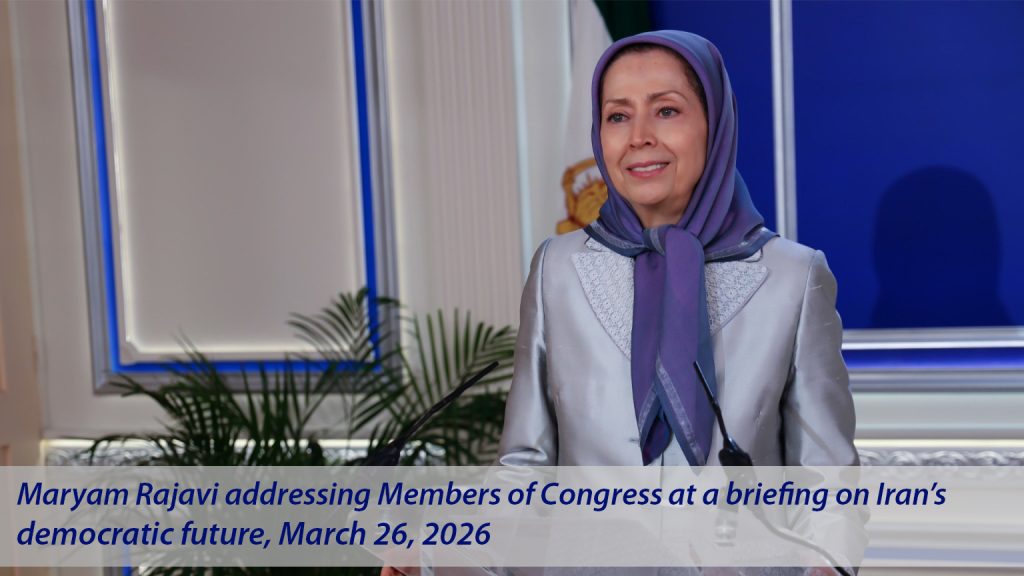
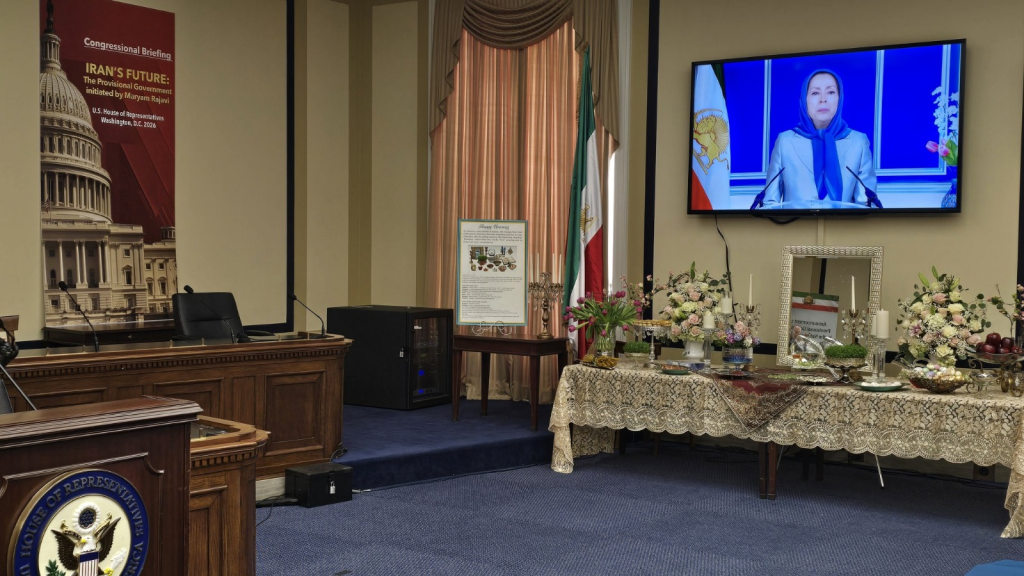
Washington, D.C., March 26, 2026. At a New Year gathering at the United States Congress, a bipartisan briefing was held on the democratic transition in Iran and the announcement of the Provisional Government of the National Council of Resistance of Iran (NCRI). The event brought together Members of Congress from both the Democratic and Republican parties, alongside a keynote address by Maryam Rajavi, President‑elect of the NCRI.
The briefing underscored strong congressional support for the Iranian people’s right to self‑determination, the rejection of both war and dictatorship, and the vision outlined in Maryam Rajavi’s Ten‑Point Plan for a democratic, secular Iran. Members of Congress, including Rob Menendez, Tim Burchett, Randy Weber, Deborah Ross, Christian Menefee, Tom McClintock, and Brad Sherman, expressed solidarity with the Iranian people and emphasized that the path forward is clear: empowering the people of Iran to determine their own future.
At the invitation of Members of Congress, Maryam Rajavi delivered a short address during the briefing. The full text of her remarks follows.
Peace and Freedom as the Vision of the Iranian Resistance
Honorable Members of the United States Congress,
Distinguished Guests,
Over the past months, two major developments have taken place in Iran: the January uprising, and the ongoing war that, in addition to Iran, has had deep and lasting effects on the geopolitics of the Middle East and on international relations, and will continue to do so.
Key Lessons of the Iranian Resistance
These events have already begun to answer important assumptions that, for many years, have shaped the political thinking of governments, major media, and policy institutions in the West—assumptions that the Iranian Resistance has warned about for decades.
Among these key lessons are:
- A policy of appeasement ultimately leads to conflict.
- This regime will never abandon its three‑pillar strategy: nuclear weapons, ballistic missiles, and proxy group programs. By giving power to Khamenei’s son, the regime has shown that it intends to continue the policies of the past 47 years without any change.
- The idea that the regime will collapse on its own is unrealistic, and this regime will not change through virtual activities or satellite programs.
- To survive, the regime is willing to commit any crime. Therefore, resistance against the mullahs’ dictatorship is the legitimate right of the Iranian people.
- The people of Iran seek the overthrow of the regime in its entirety.
The solution to the crisis in Iran is the overthrow of the regime—a goal that can only be achieved by the Iranian people themselves and through their organized resistance.
“The slogan of the Iranian Resistance and the provisional government is peace and freedom.”
What Is the Solution?
Honorable Dignitaries,
These realities have been the subject of the consistent warnings that the National Council of Resistance of Iran (NCRI) has issued over the past four decades. From the beginning, we have stated that the solution lies in the overthrow of this regime, and that the answer is in the hands of the Iranian people themselves.
As the Declaration of Independence states, the American people were once subjected to the most barbaric and brutal acts. Yet it was the American people who freed themselves from that oppression. Today, it is the people of Iran who will bring freedom to their country.
In January of this year, the regime killed thousands of unarmed protesters in the streets and displayed images of their bodies in black bags on its own state television.
What is the response to a regime that massacres protesters?
The answer lies with the Iranian people and the youth: the Resistance Units and the Liberation Army.
In the early hours of February 23, units of this army carried out an attack against one of the regime’s most important leadership centers—Khamenei’s headquarters.
This Resistance relies on the experience and commitment of the main opposition force, the People’s Mojahedin Organization of Iran (MEK), which has fought against this regime for 47 years. Over several decades, they have promoted a culture of steadfastness and willingness to pay the price for freedom in Iranian society. Today, they have become the focal point of hope for masses of youth who have both the power and the determination to fight the IRGC.
A Viable Solution with Historical Backing
The people of Iran have succeeded in presenting a credible solution with strong historical and social support: a democratic alternative—the National Council of Resistance of Iran.
This alternative rejects both the former monarchical dictatorship and the current religious tyranny. It looks to the future rather than returning to the past or sustaining the present situation. Continuing the status quo or reverting to the past would mean ongoing oppression and poverty for the people of Iran, and instability and conflict for the region.
Based on its Ten‑Point Plan, the NCRI has declared a provisional government.
The slogan of the Iranian Resistance and the provisional government is peace and freedom.
It is encouraging that a majority of members of the U.S. House of Representatives, through Resolution 166, have emphasized the Ten‑Point Plan and the need for the establishment of a republic based on the separation of religion and state. This resolution presents a credible framework for policy toward Iran.
The Iranian Resistance has repeatedly declared that it does not ask for boots on the ground, money, or weapons from foreign countries. However, at this critical moment, the Iranian people and the Resistance call for the following:
- Recognition of the NCRI’s provisional government to enable the transfer of sovereignty to the people of Iran;
- Effective technical support to ensure the Iranian people’s access to the internet;
- Expulsion of agents of the regime from U.S. soil.