NCRI Warns of Imminent Massacre and Calls for Urgent International Action
By NCRI-US Staff
Paris, France — April 1, 2026. In a news briefing addressed to the media, Mr. Mohammad Mohaddessin, Chair of the Foreign Affairs Committee of the National Council of Resistance of Iran (NCRI), condemned the recent executions of four members of the People’s Mojahedin Organization of Iran (PMOI/MEK). He warned that these killings signal a dangerous escalation by the Iranian regime and could be a prelude to another massacre of political prisoners, similar to the mass executions of 1988. Mr. Mohaddessin called on the United Nations, Western governments, and the international community to take immediate and decisive action to halt the executions and recognize the Iranian people’s right to resist tyranny.
Remarks by Mr. Mohammad Mohaddessin
Chair, Foreign Affairs Committee – NCRI
Paris | April 1, 2026
Ladies and gentlemen,
Good afternoon, and good morning to those joining us from across the Atlantic.
Iran today is confronting a new wave of political executions.
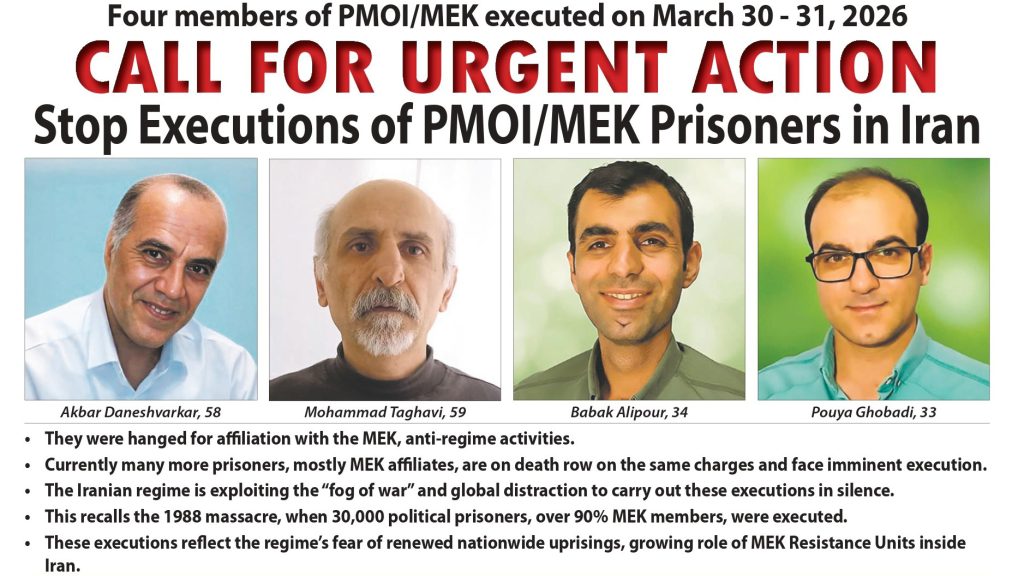
Over the past two days, four members of the People’s Mojahedin Organization of Iran (PMOI/MEK)—Mohammad Taghavi, Akbar Daneshvarkar, Babak Alipour, and Pouya Ghobadi—were executed.
Last week, three other prisoners arrested during the January uprising were also executed.
Mohammad Taghavi, aged 59, was an architect; Akbar Daneshvarkar, 60, a civil engineer; Babak Alipour, 34, a legal expert; and Pouya Ghobadi, 33, an electrical engineer. They were arrested in late 2023 and early 2024 and subjected to torture and the most severe pressures in Ward 209 of Evin Prison.
In December 2024, after months of interrogation and torture, they were sentenced to death on charges of “membership in the PMOI” by the notorious Judge Iman Afshari, head of Branch 26 of Tehran’s so‑called Revolutionary Court. Their sentences were later upheld by the Supreme Court.
Despite sustained pressure during detention, all four remained steadfast in their positions. They had previously been arrested multiple times. For example, Mohammad Taghavi had spent a total of eight years in prison.
Two other associates of these four—Abolhassan Montazer, 67, and Vahid Bani Amerian, 33—remain on death row.
The execution of these four has provoked tremendous outrage among Iranians and opposition groups seeking the overthrow of the regime and the establishment of a democratic republic in place of the current theocracy.
I must warn that what we are witnessing may be a prelude to a massacre of political prisoners, similar to 1988, when the regime, facing the consequences of its defeat in the war with Iraq, carried out mass executions. In that massacre, 30,000 political prisoners were executed, more than 90 percent of them PMOI members.
We call on the UN Secretary‑General, the Security Council, the High Commissioner for Human Rights, and all UN member states, as well as the United States and the European Union, to take urgent action to halt the execution of political prisoners in Iran, particularly the two PMOI members facing imminent execution.
Please watch a short clip about the four executed political prisoners.
They were members of the PMOI’s Resistance Units, which play a leading role in breaking the atmosphere of repression, preparing the ground for protests and uprisings, and helping organize and sustain them, as was evident during the January uprising.
More than 2,000 members of the Resistance Units disappeared during the January uprising. Some who were arrested now face execution.
In its own official statements regarding these four individuals, the regime’s judiciary explicitly acknowledges that:
- They participated in uprisings and were considered “enemies of the state.”
- They targeted repression centers, including the Ministry of Intelligence and security agencies, using launchers.
- They were militarily self‑sufficient and manufactured equipment themselves.
- They raised funds for their activities.
- They were fighting to overthrow the regime.
These four men were imprisoned for two and a half years and sentenced to death a year and a half ago.
The question is: Why were they executed now, in the midst of an external war?
The answer is clear. More than any external conflict, the regime leadership is profoundly alarmed by the domestic situation and the possibility of another nationwide uprising.
This war has revealed several critical realities:
First, the regime will not be overthrown from the air.
Second, this war will come to an end.
Third, once the war ends, Iranian society will become far more explosive, leading to even more intense uprisings.
Fourth, regardless of how the war concludes, the regime will emerge significantly weaker and more vulnerable.
The regime’s principal concern today is how to confront the uprisings on the horizon and how to prevent its own overthrow.
As we have repeatedly stated, overthrow requires a powerful, indigenous force rooted within society.
Such a force exists in the form of the PMOI’s Resistance Units. Taking shape 12 years ago, they are now active across all 31 provinces and are evolving into a liberation army.
Over the past year alone, these units carried out 4,092 anti‑repression operations. During the January uprising, they conducted 630 operations to confront the regime’s repressive forces and protect demonstrators.
What the regime itself has acknowledged about these four executed members is only a small reflection of the capabilities of this organized internal force.
A major turning point was the bold operation of February 23, when 250 PMOI fighters targeted the headquarters of Ali Khamenei in the heart of Tehran—the most heavily guarded location in the country.
In that operation, 100 PMOI members were killed or arrested, while 150 withdrew safely. The regime also suffered significant casualties.
Among those detained on February 23, the Resistance has identified 82 individuals, aged 18 to 69, who were killed or arrested, and has submitted their information to the United Nations.
Despite wartime security conditions, operations by the Resistance Units have continued and expanded. On Monday, March 16, in response to the crackdown on—and torture of—prisoners in Khuzestan Province, a unit of the Liberation Army attacked the governor’s office in Ahvaz.
These units also carried out 31 operations on March 3 and 20 operations on March 15 against the IRGC, the Basij, and other repressive institutions.
On February 28, the National Council of Resistance of Iran, based on the Ten‑Point Plan of its President‑elect, Mrs. Maryam Rajavi, announced a provisional government to transfer sovereignty to the Iranian people.
The mission of this government, following the overthrow of the clerical regime, is to hold free and fair elections within less than six months for the election of a national constituent assembly.
The motto of this provisional government is “Peace and Freedom.” It stands for a democratic republic that rejects both religious dictatorship and monarchical fascism.
As Mrs. Maryam Rajavi stated yesterday, these recent executions reflect the clerical regime’s fear and desperation in the face of an enraged population and growing support for the Resistance Units and the Liberation Army.
Carrying out such executions amid an external war is a clear admission that the regime’s principal enemy is the Iranian people and their Resistance. Although the regime seeks to exploit external conflict to conceal its deep and unresolved internal crises, it cannot escape its inevitable overthrow by the people and the Resistance.
Today, many prisoners, especially PMOI members, are at risk of execution. Beyond the four already executed, the death sentences of 15 others have been confirmed by the Supreme Court and await implementation. In addition, many more political prisoners are likely to receive death sentences.
The United Nations, its member states, and all defenders of human rights must unequivocally condemn these executions and take effective measures to halt executions in Iran.
Ladies and gentlemen,
The international community must uphold its responsibilities. We specifically call for:
- The closure of embassies and expulsion of the regime’s terrorist diplomats and agents
- Recognition of the provisional government
- Recognition of the right of the Iranian people and their Resistance to confront the IRGC and overthrow the regime
Iran’s Resistance is fighting for a democratic republic based on the Ten‑Point Plan: grounded in the people’s vote, separation of religion and state, equality for all nationalities and religious communities, and a non‑nuclear, peace‑seeking Iran that pursues coexistence and equal relations with the world.
Such a republic will be a force for stability, peace, and security, and a decisive factor in ending extremism and terrorism in the region and beyond.
Thank you very much.
I look forward to your questions.