By the NCRI-US Staff, June 18, 2025
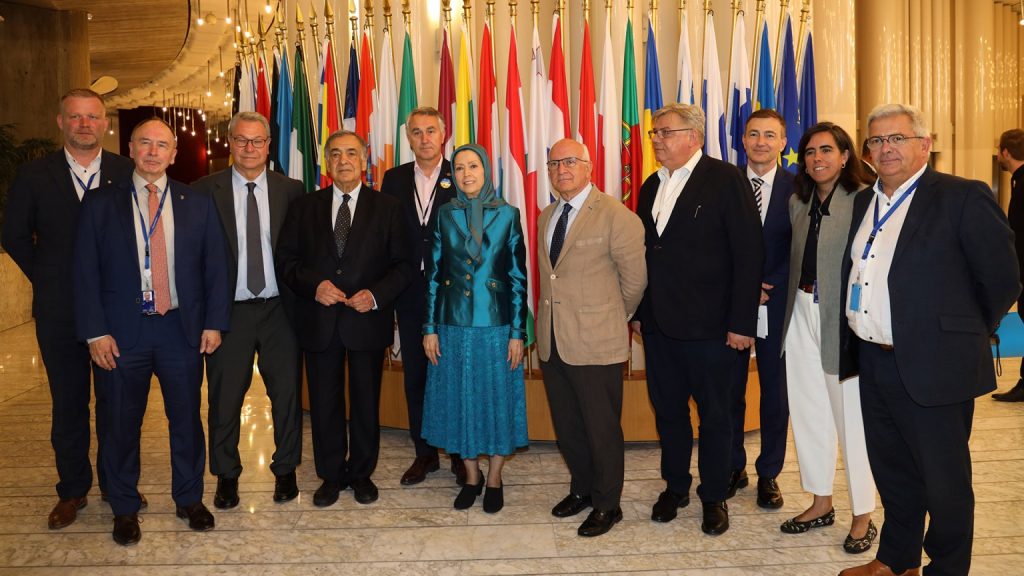
STRASBOURG, France – June 18, 2025 – Maryam Rajavi, President-elect of the National Council of Resistance of Iran (NCRI), delivered a powerful speech today at the European Parliament, reiterating her long-standing call for regime change in Iran and asserting that the clerical dictatorship is on the verge of collapse. Her address, a follow-up to her previous appearance in November 2024, emphasized the urgent need for a fundamental shift in the international community’s approach to Iran.
“The crisis of overthrow has now engulfed the entire clerical dictatorship — a reality that is visible to all,” Rajavi stated, drawing parallels to the recent dramatic events in Syria. “It is especially evident to those who witnessed the fate of Bashar al-Assad and the turning point in Syria this past December. No one anticipated it, yet it was real, and it came to pass.”
Rajavi highlighted a new chapter in Iran’s internal crisis and the broader regional dynamics, referencing a “war that broke out at dawn on Friday, June 13, 2025.” However, she stressed that the central and ongoing conflict, unfolding over the past 44 years since June 20, 1981, remains the struggle of the Iranian people and the Iranian Resistance against the ruling religious fascism.
“The only viable solution remains the overthrow of this regime by the people of Iran and the Iranian Resistance,” she asserted, recalling her address to the same parliament 21 years ago. At that time, she warned that “the policy of appeasement encourages the clerical regime to persist in its policies and, ultimately, imposes war upon Western nations,” urging against a repeat of “the Munich experience—with clerics armed with nuclear bombs.”
Today, Rajavi observed, “we see that appeasement has indeed led to the imposition of war.” She unequivocally stated, “lasting peace and security in this part of the world require regime change in Iran, brought about by the people of Iran and the Iranian Resistance.”
The NCRI leader reiterated long-held positions of the Iranian Resistance:
“From the outset, our Resistance made it clear: a viper never gives birth to a dove — and religious dictatorship is inherently incapable of reform.”
“This regime thrives on exporting terrorism and fundamentalism, relentlessly pursues nuclear weapons, and will never relinquish its uranium enrichment program. These truths have been proven.”
“We said from the outset that negotiations with and appeasement of this regime would lead nowhere — that it would serve only to buy time and offer the regime new opportunities to strengthen its grip. This, too, was a reality — and it has been definitively proven.”
Rajavi notably reminded the European Parliament that it was the Iranian Resistance that first exposed the clerical regime’s secret nuclear facilities in August 2002. She highlighted acknowledgments from then-U.S. President George W. Bush and his administration that the world had been unaware of the regime’s bomb-making project until the Iranian Resistance intervened.
“On that day, the question before the world was clear: what must be done?” Rajavi recounted. Her consistent answer has been the “Third Option: neither appeasement nor war, but regime change at the hands of the Iranian people and their organized, legitimate, and just Resistance.”
She also pointed out the “bitter irony” that the very Resistance exposing the regime’s nuclear ambitions was blacklisted by Europe and the United States, rather than the regime and its Revolutionary Guards. This designation was finally annulled by the European Union in 2009 and the United States in 2012.
“I offer this reminder to underscore the legitimacy and authenticity of the Third Option,” Rajavi said. “We have made it clear: we do not seek money, nor do we ask for weapons. What we have always wanted is to resist — just as you Europeans once did — against religious fascism. We only ask that this Resistance be recognized. Nothing more.”
Despite this, Rajavi lamented that even this “most basic right has been denied to our people and to our Resistance to this day.” She extended gratitude to the members of the European Parliament and over 4,000 legislators across the Atlantic who have consistently defended this right.
In conclusion, Rajavi firmly stated, “The solution to this war and crisis lies in the overthrow of this regime and regime change by the Iranian people and their Resistance.” She presented the National Council of Resistance of Iran, which celebrates its 44th year, as “a concrete alternative — one with a clear program and a long history of relentless struggle against this religious dictatorship.”
She underscored that this alternative “cannot be imposed from above, as was done a century ago when Britain installed a monarch by appointment. Nor can it be forced upon the people like the 1953 coup d’état by the United States against the nationalist government of Dr. Mossadegh and through repression, executions, and torture.”
Rajavi asserted that had a legitimate nationalist and democratic government been in place, “the course of Iran’s history — and indeed the fate of this region — would have been profoundly different. Khomeini and the mullahs would have never seized power.”
Despite the historical challenges, she declared, “the people of Iran and their freedom-loving children never surrendered.” She highlighted the People’s Mojahedin Organization of Iran’s 60-year struggle against two dictatorships – the Shah’s monarchic regime and the mullahs’ religious regime – a struggle marked by “not a single day of pause or interruption.”
“Likewise, the prisons, torture chambers, and firing squads of both the Shah’s regime and the clerical regime have operated without interruption — until the day they are finally overthrown,” she said. “That is precisely why we say: neither the Shah nor the mullahs — the people of Iran will accept no form of dictatorship and demand freedom. Yes, a free Iran. That is exactly why I am here today.”