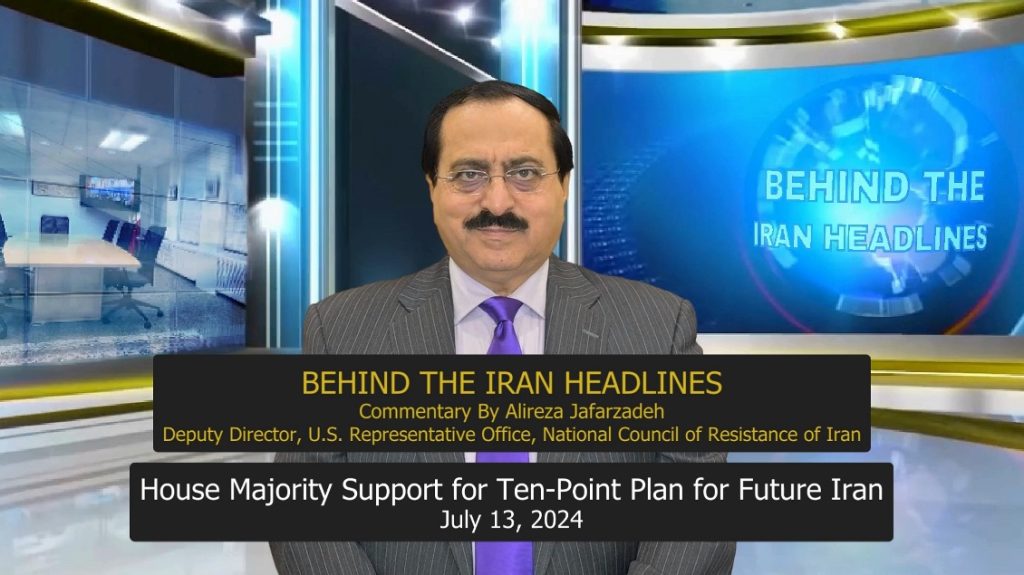
BEHIND THE IRAN HEADLINES Series, July 7, 2024, Alireza Jafarzadeh, NCRI-US Deputy Director
During the Free Iran 2024 Summit in Paris and Berlin, a bipartisan group of members of the U.S. House of Representatives announced that a House Resolution had surpassed the support of the majority of members.
The resolution, H.Res.1148, was introduced by Congressman Randy Weber of Texas and endorsed by an impressive House majority that included dozens of Committee and subcommittee chairs and ranking members, some of whom made their bi-partisan representation at the Free Iran Summit in Paris. The resolution condemns terrorism by stating, “The Iranian regime has increasingly acted, since October 2023, as the head of the snake of terrorism and war in the region.”
This resolution states that significant protests in Iran “have echoed the demand for the rejection of the Velayat-e Faqih to safeguard the sovereignty of the people in a republic founded on universal suffrage and pluralism.”
The resolution highlights that “over 3,600 parliamentarians around the world and 125 former world leaders expressed support for the Ten-Point Plan for the Future of Iran of Mrs. Maryam Rajavi that calls for the universal right to vote, free elections, a market economy, and separation of religion and state, and advocates gender, religious, and ethnic equality, a foreign policy based on peaceful coexistence, peace in the Middle East, and a nonnuclear Republic of Iran.”
This bi-partisan resolution acknowledges and upholds the Iranian people’s inherent right to determine their political future and calls to support the Iranian Resistance’s Ten-Point Plan for the Future of Iran.
This legislation urges the free world “to recognize the rights of the Iranian people, the protesters, and the Resistance Units to confront the Islamic Revolutionary Guard Corps (IRGC) and repressive forces to bring about change.”
It also “recognizes the rights of the Iranian people and their struggle to establish a democratic, secular, and nonnuclear Republic of Iran.”
Indeed, as Tehran struggles with the aftermath of Raisi’s death, the Iranian Resistance is showing its organizational capability, increasing activities in Iran, and expanding its international support.