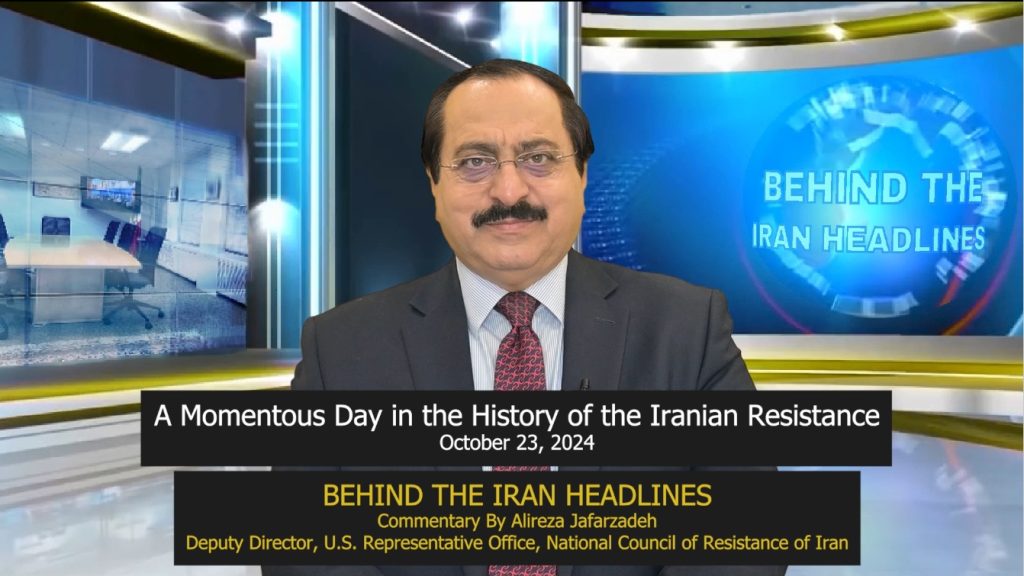
BEHIND THE IRAN HEADLINES Series, October 21, 2024, Alireza Jafarzadeh, NCRI-US Deputy Director
October 22, 1993, marks a momentous day in the history of the Iranian Resistance, which has long strived to realize the century-old aspirations of the Iranian people for democracy, equality, and popular sovereignty.
On that day, the National Council of Resistance of Iran (NCRI), a democratic coalition of Iranian opposition groups and personalities established in 1981 in Tehran, elected Mrs. Maryam Rajavi as its President-elect for the period to transfer sovereignty to the people of Iran, after the NCRI leads the movement to overthrow the mullahs’ regime.
Mrs. Rajavi’s role as the provisional government’s president is to provide leadership during the transition, ensuring that the foundations for a democratic, secular, and just society are established and that power is handed over to a government genuinely elected by the people of Iran. Her mandate ends once the new constitution is ratified and a new president is elected.
During the transitional period, Mrs. Rajavi’s key responsibilities include:
- Formation of a provisional government
- Organizing free and fair elections within six months
- Ensuring the rule of law and human rights
- Dismantling repressive state institutions
- Establishing secular governance
- Promoting gender equality
- Abolishing capital punishment
- Ensuring economic stability and social welfare
- Maintaining international relations and peace
A provisional government is crucial immediately following the regime’s ousting. It ensures that the transition process is orderly, legitimate, and secure, giving the people the best chance for a peaceful and sustainable transition to democracy.
In 2006, during a speech at the Council of Europe, Mrs. Rajavi introduced her 10-point plan for Iran’s future, presenting a vision for a free, democratic, secular, non-nuclear republic that prioritizes human rights, gender equality, and the rule of law while committing to peace and regional stability. It outlines the principles and policies that the NCRI will implement after the fall of the current regime.
The 10-point plan has received widespread support, with endorsements from 125 former world heads of state and leaders, over 4,000 lawmakers from 41 countries representing 34 parliamentary majorities—including a bipartisan majority in the U.S. Congress—and 80 Nobel Laureates.
Under Maryam Rajavi’s leadership, the NCRI has provided a clear roadmap for Iran’s transition. Her role is pivotal in ensuring that democracy, equality, and freedom form the foundation of Iran’s future.