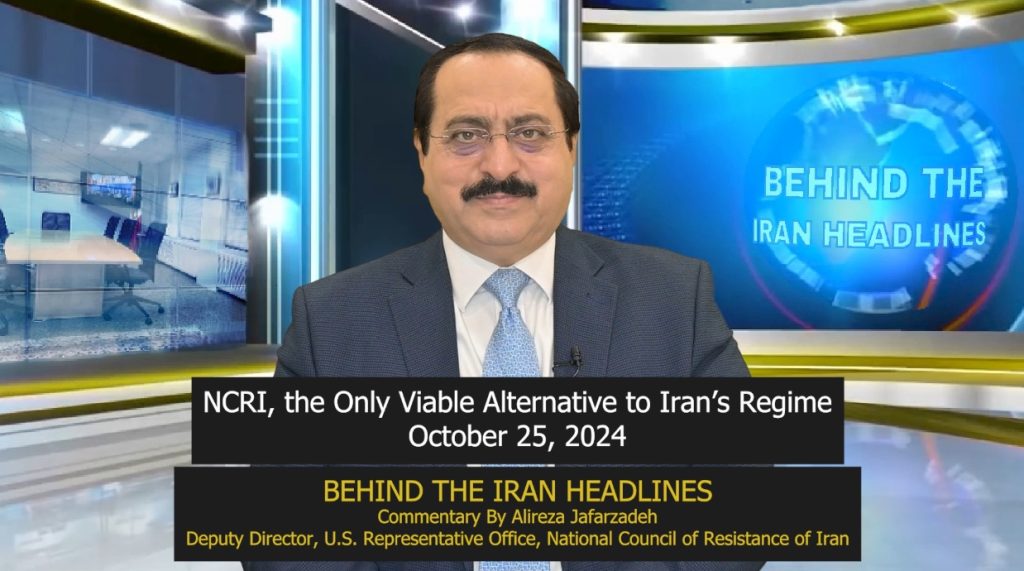
BEHIND THE IRAN HEADLINES Series, October 25, 2024, Alireza Jafarzadeh, NCRI-US Deputy Director
The democratic coalition National Council of Resistance of Iran (NCRI) is the democratic alternative to the current regime. Here’s why:
1) The Enduring and Unified Coalition: Founded in 1981 in Tehran, the NCRI functions as a coalition of opposition groups and personalities, with the Mujahedin-e Khalq, the MEK, as its principal member. As the most enduring political coalition in Iran’s history, the NCRI has brought together diverse political, ethnic, and social groups for the goal of regime change.
2) Paying the Price: Since 1981, over 100,000 members of this movement have been murdered by the regime. In 1988, a fatwa issued by then-Supreme Leader Khomeini led to the massacre of 30,000 political prisoners, 90% of them associated with the MEK. The movement has been the main target of numerous terror plots abroad while facing a significant demonization campaign led by Tehran’s Ministry of Intelligence and the IRGC.
3) Strong Organizational Network Inside Iran: The activities of the MEK’s Resistance Units display the ability to organize protests and challenge the regime’s authority on the ground, demonstrating a critical operational capability for change and ensuring tranquility during the transition. Additionally, the NCRI, relying on the MEK network inside Iran, has unveiled the nuclear weapons program of the Iranian regime, most notably the nuclear site in Natanz. This 2002 revelation triggered the inspections of Iranian nuclear sites by the IAEA that eventually led to the adoption of six UN Security Council Resolutions against the regime.
4) Clear, Operational Blueprint for Transition: The NCRI has articulated a comprehensive vision for Iran’s future through the Ten-Point Plan of its President-elect, Maryam Rajavi. This plan separates religion and state, guarantees human rights, gender equality, freedom of religion and expression, a free market economy, and a non-nuclear republic. After the regime’s fall, NCRI will act as the provisional government to ensure a peaceful transition and prepare for free and fair elections within six months to form a National and Constituent Assembly.
5) Proven Resilience Against Repression: Tehran has made key demands from foreign governments to classify the movement as terrorists, extradite them to Iran, or restrict their activities. Nevertheless, the Iranian Resistance has prevailed in legal challenges in Europe and the U.S., successfully removing itself from such designations globally. Even further, this alternative facilitated the terrorist designation of the IRGC in the U.S., Canada, and Europe.
6) Unwavering Commitment to Democracy: The NCRI’s consistent emphasis on establishing a free, secular republic aligns with the aspirations of the Iranian people who have been chanting “Down with the oppressor, be it the Shah or the Supreme Leader” in the streets of Iran, a clear rejection of both the monarchical dictatorship and the current theocracy.
7) International Recognition: The NCRI has garnered significant international support. Mrs. Maryam Rajavi has been invited to speak at international forums. Her 10-point plan has received endorsements from 125 former world heads of state and leaders, over 4,000 lawmakers from 41 countries representing 34 parliamentary majorities—including a bipartisan majority in the U.S. Congress—and 80 Nobel Laureates.
Indeed, the NCRI’s combination of on-the-ground capabilities, international outreach, and coherent political vision is unmatched, setting it as the only viable alternative to effect change as well as to lead a post-regime transition.