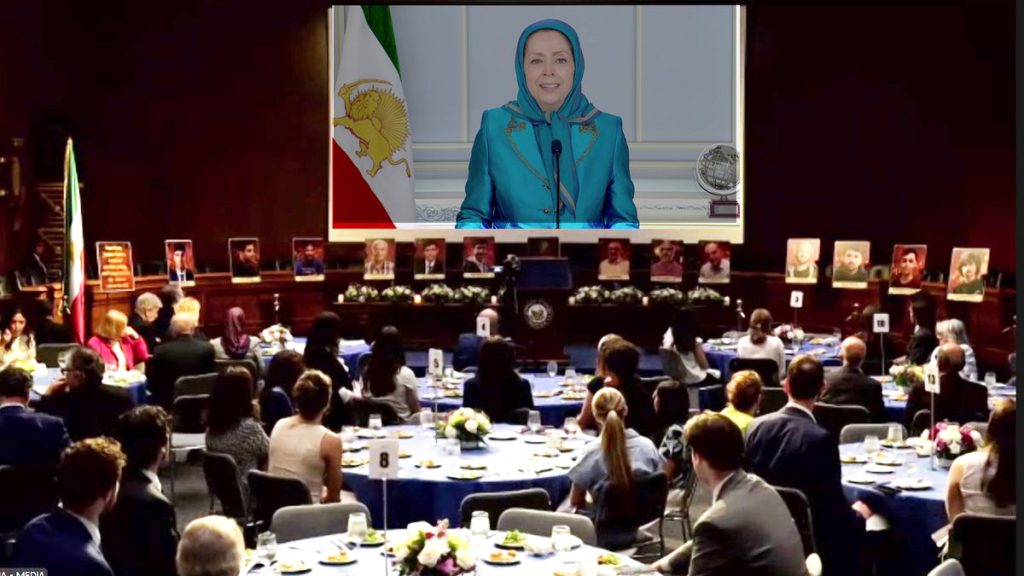
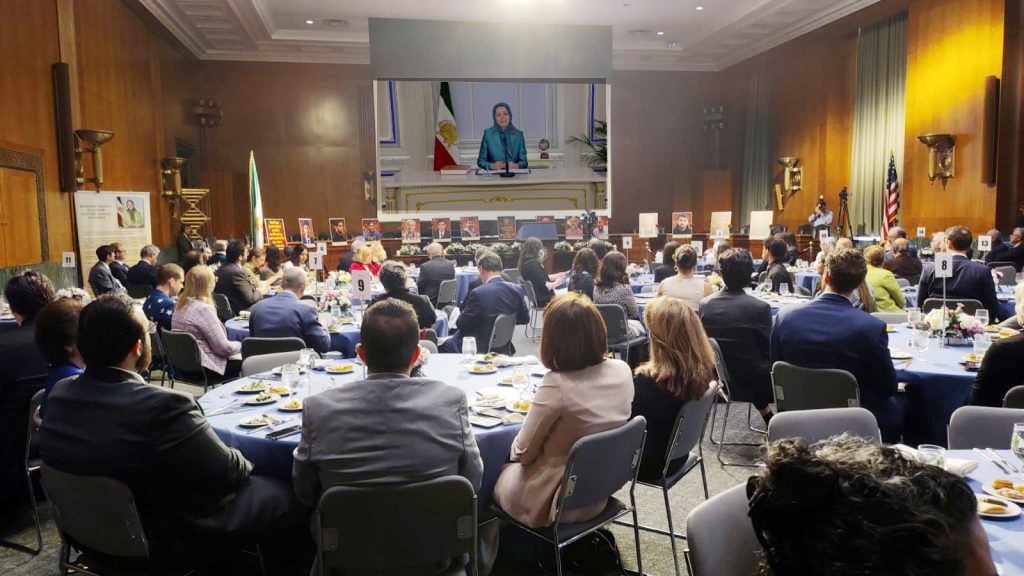
On April 16, 2026, a briefing titled “Iran: Towards Peace and Freedom” was held at the United States Senate in the Dirksen Senate Office Building. The event brought together U.S. senators, former ambassadors, policymakers, and experts to examine the ongoing crisis in Iran and a path toward stability and democratic change.
At the briefing, Mrs. Maryam Rajavi, President‑elect of the National Council of Resistance of Iran (NCRI), delivered the following address. Her remarks focused on the role of the Iranian people and their organized resistance, the limitations of past international approaches toward Iran, and her vision for a peaceful transition grounded in democratic principles.
Message of Mrs. Maryam Rajavi, President‑elect of the National Council of Resistance of Iran
U.S. Senate Briefing: “Iran: Towards Peace and Freedom”
106 Dirksen Senate Office Building
Thursday, April 16, 2026
Distinguished Senators,
Senator Blunt, Ambassador Brownback, Ambassador Sands, Ambassador Ginsberg,
Ladies and Gentlemen,
In these critical circumstances, I am honored to have the opportunity to speak with you. I sincerely appreciate your attention to the struggles of the Iranian people for peace and freedom.
Today, more than ever, a fundamental question is before us: What is the real solution to Iran’s crisis?
Over the past forty‑seven years, nearly every approach has been tested. These have included policies of appeasement, Europe’s so‑called “critical dialogue,” negotiations, and even war. Yet all have failed because the regime would lose its power if it were to accept any reform.
The regime is weaker than ever before, but its nature remains unchanged. It will neither revise its policy of repression nor abandon its efforts to obtain a nuclear weapon, support terrorist proxies, and interfere in the affairs of countries in the region.
Since March 19, at least thirteen political executions have taken place in Iran, including six MEK members and seven defiant protesters. They were all accused of working to overthrow the regime. Through these executions, the regime is intensifying an atmosphere of terror in an effort to prevent another uprising.
Despite decades of repression, there is a determined, selfless, and organized resistance inside Iran. This movement is prepared to pay the highest price for freedom and has risen through multiple massacres. It also has four decades of experience confronting the Revolutionary Guard Corps (IRGC).
Its strategy—based on organized resistance against the IRGC and reliance on popular uprisings—has attracted unprecedented support among Iran’s youth over the past year.
I must emphasize that the people of Iran do not wish to return to the dictatorship of the Shah.
We believe the ceasefire was the most appropriate decision at a highly sensitive moment by the United States. We hope this step will lead to an end to the war and open a path toward peace and freedom. However, real and lasting peace can only be achieved through the overthrow of the ruling religious dictatorship by the people of Iran and their organized resistance.
In recent days, Khamenei’s son claimed that more than seventeen million people are ready to sacrifice their lives for the regime. If this claim is true, he should accept a free election under United Nations supervision and based on the principle of popular sovereignty, not clerical rule. However, the ruling theocracy does not have the courage to accept such a test.
Missing Element in Western Policy
Honorable Senators,
This is a critical moment—not only in our history, but also in the history of the Middle East and the world. It is also a moment to take responsibility and adopt the right policy.
Over the years, the most important missing element in Western policy has been the failure to recognize the role of the Iranian people and their organized resistance in bringing about change. While attention has focused on engagement with the regime or on containing it, the Iranian people and their resistance have been overlooked.
I urge lawmakers to focus their attention on supporting the Iranian people and the organized resistance inside the country, including the Resistance Units standing on the front lines of the struggle for freedom.
On the political terrain, the National Council of Resistance of Iran offers a credible framework for a peaceful transition by holding a free election within six months after the fall of the regime. Power would then be handed over to the elected representatives of the people.
At the heart of this vision is the Ten‑Point Plan, which outlines a future for Iran based on free elections, gender equality with women’s participation in political leadership, separation of religion and state, recognition of the rights of oppressed ethnic groups, a non‑nuclear policy, and peaceful coexistence. This is a plan for stability, democracy, and peace.
The solution to the crisis in Iran lies in its people, in their courage, and in their organized resistance. The question is no longer whether change is possible, but whether the world is prepared to recognize the Iranian people’s resistance and stand on the right side of history.
I call on all of you to support the Iranian people and their resistance in their effort to bring about regime change.
Thank you all.