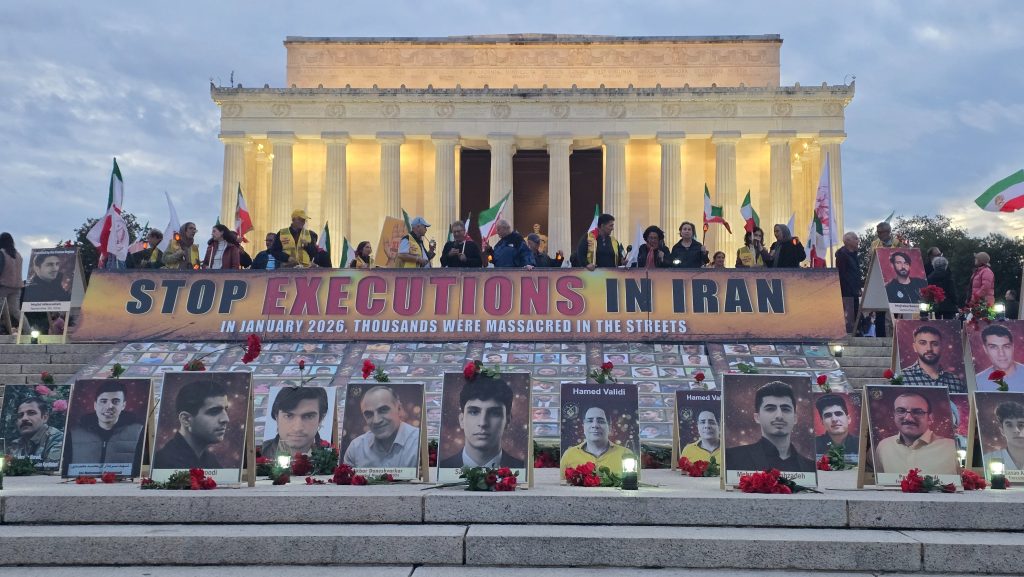
Vigils, exhibitions and solidarity runs across the United States and Europe call for an immediate halt to executions, accountability, and democratic change in Iran
By NCRI-US Staff
WASHINGTON, Oct. 11, 2026 — Supporters of the National Council of Resistance of Iran (NCRI) and Iranian communities across the United States and Europe marked World Day Against the Death Penalty with vigils, photo exhibitions, rallies and solidarity runs as Iran’s ruling regime intensifies executions of protesters, dissidents and political prisoners.
At the Lincoln Memorial in Washington on October 10, Iranian Americans held a candlelight vigil and photo exhibition honoring victims of repression and political executions. Participants called for an immediate halt to executions, freedom for political prisoners and international accountability for regime officials.
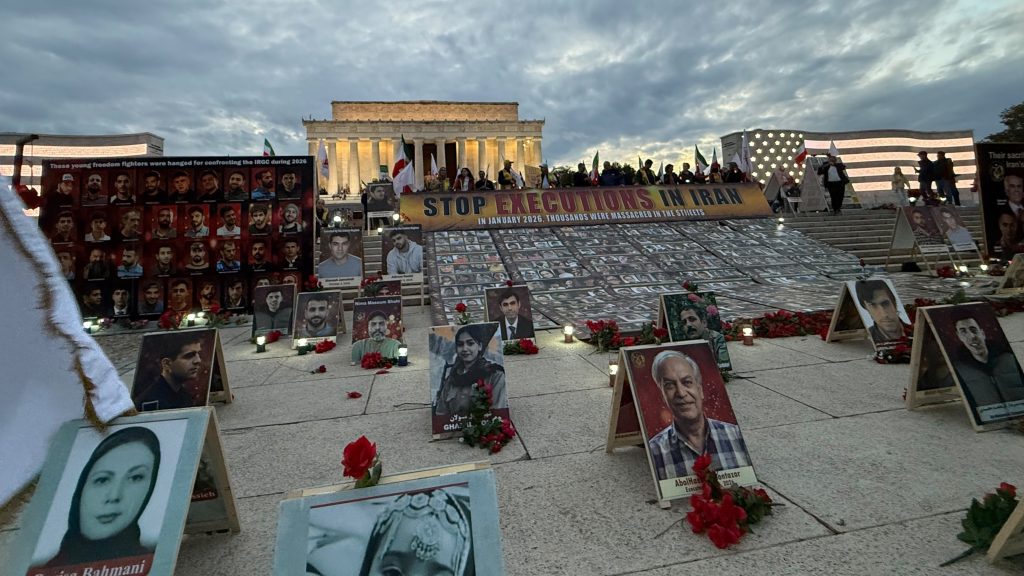
Alireza Jafarzadeh, deputy director of the NCRI’s U.S. Representative Office (NCRI-US), highlighted the occasion and said: “On the World Day Against Death Penalty, NCRI supporters’ vigil at the Lincoln Memorial in Washington, DC, demanded an immediate stop to executions in Iran and accountability for regime officials. Their message: achieving a democratic, free, republic in Iran requires regime change by Iran’s people.”
Activities also took place in several U.S. cities. In San Francisco, NCRI supporters rallied at Union Square, calling for urgent international action to stop executions and expressing support for a free and democratic Iran. In Houston, NCRI supporters held a photo exhibition at Hermann Square Park in front of City Hall, drawing attention to political prisoners and protesters facing execution. Iranian Americans in the Los Angeles area also marked the occasion with a local community activity against executions. Similar activities were held in Atlanta and Dallas.
The campaign extended across Europe. In Amsterdam, supporters held a run against executions. In Paris, participants gathered at Parc Montsouris for a solidarity run, while supporters in Stockholm held a five-kilometer run outside Sweden’s Parliament. Other rallies, exhibitions, book stands and public actions took place in Germany, Switzerland and elsewhere, combining demands to stop executions with support for a secular, democratic republic.
The campaign also extended to Canada, where Iranian-Canadian supporters of the Resistance marked World Day Against the Death Penalty with an anti-execution activity in solidarity with political prisoners in Iran.
Executions and Repression Intensify
The activities came amid an escalating human-rights crisis. Amnesty International recorded 2,159 executions in Iran in 2025, the highest annual figure it has recorded there in decades. Amnesty has described the death penalty as an increasingly important instrument of political repression, alongside its extensive use for drug-related and other offenses.
Repression intensified after the January 2026 uprising. Amnesty said that by late May, at least 39 people had been arbitrarily executed on politically motivated charges following grossly unfair trials.
Members and supporters of the People’s Mojahedin Organization of Iran (PMOI), also known as the Mujahedin-e Khalq (MEK), have been among those targeted. Reuters reported on April 4 that the regime executed two men with affiliated with the MEK. Later that month, Reuters reported that NCRI President-elect for the transitional period Maryam Rajavi said eight MEK-affiliated prisoners were among 16 political prisoners executed during the preceding month.
The crackdown has continued against participants in the January uprising. An October 8 Reuters investigation found that the regime’s security agencies, judiciary and state media were working in concert to track, prosecute and intimidate protesters. Reuters reported thousands of arrests, rapid executions, closed-door proceedings, coerced televised confessions and state broadcasts designed to spread fear. At least 34 protesters had been executed by the time of the investigation.
Immediate Action and Democratic Change
The international activities carried two related messages: governments must act immediately to prevent further executions, while the underlying machinery of repression cannot be permanently dismantled without fundamental political change in Iran.
Participants called on governments and international institutions to increase pressure on the regime, demand a halt to executions, defend political prisoners and pursue accountability for officials responsible for executions, torture and other serious human-rights violations.
Maryam Rajavi, NCRI President-elect for the transitional period, has made abolition of the death penalty a central commitment for a future Iran. Her Ten-Point Plan calls for abolition of capital punishment, an independent judiciary, equality before the law, separation of religion and state, and adherence to international human-rights standards.
The message conveyed by supporters across the United States and Europe was that international action can help save lives now, but lasting change requires ending the ruling dictatorship through the struggle of the Iranian people and establishing a free, secular, and democratic republic.
About the Iranian Resistance
The National Council of Resistance of Iran (NCRI) is a coalition advocating a democratic, secular republic in Iran. Maryam Rajavi, the NCRI’s President-elect for the transitional period, has outlined a Ten-Point Plan for a future democratic Iran. The People’s Mojahedin Organization of Iran (PMOI), also known as the Mujahedin-e Khalq (MEK), is the NCRI’s principal organized movement.