Iran’s Democratic Future Marks a Break With Both Monarchy and Theocracy
By NCRI-US Staff
WASHINGTON, Oct. 9, 2026 — A federal court ruling allowing a torture lawsuit against former senior SAVAK official Parviz Sabeti to move forward has reopened the record of repression under the Shah as Iran’s democratic movement insists that the country’s future must break with both hereditary and clerical dictatorship.
On October 7, U.S. District Judge Gregory A. Presnell rejected Sabeti’s attempt to end the case on statute-of-limitations grounds. Three former political prisoners are suing him under the Torture Victim Protection Act, alleging that SAVAK abducted, imprisoned, and tortured them during Mohammad Reza Shah Pahlavi’s rule. Sabeti denies involvement in torture.
SAVAK Torture Was Documented Before the Shah’s Fall
Sabeti headed SAVAK’s powerful Third Directorate, responsible for internal security and political opposition. SAVAK torture was documented well before the Shah’s overthrow. A 1976 congressional hearing examined extensive evidence of political repression. Amnesty International documented beatings, electric shocks, burning, and other abuses. In June 1979, The New York Times reported that former SAVAK interrogator Bahman Naderipour, known as “Tehrani,” admitted in court to torturing hundreds and participating in killings.
For the Iranian Resistance, the Record Is Personal
For the National Council of Resistance of Iran (NCRI), this history is personal. In February 2023, 131 former political prisoners affiliated with the People’s Mojahedin Organization of Iran (PMOI), also known as the Mujahedin-e Khalq (MEK), recounted their experiences in the Shah’s prisons and declared themselves ready to testify about SAVAK torture and Sabeti’s role. Additional former MEK prisoners later joined them.
“Many members of this Resistance know SAVAK not from books, but from interrogation rooms and torture chambers,” Soona Samsami, the NCRI’s U.S. Representative, said. “Tens of thousands of our members and supporters were subsequently imprisoned, tortured, or executed by the ruling theocracy. That experience is precisely why our democratic movement draws an unambiguous line against both dictatorships.”
Sabeti’s Return Revived the Shah’s Repressive Legacy
Sabeti had remained largely outside public view for decades. That changed in February 2023, when his daughter, Pardis Sabeti, posted a photograph with her parents at a U.S. rally by Reza Pahlavi supporters. The image spread widely and triggered outrage among former political prisoners and opponents of the former monarchy.
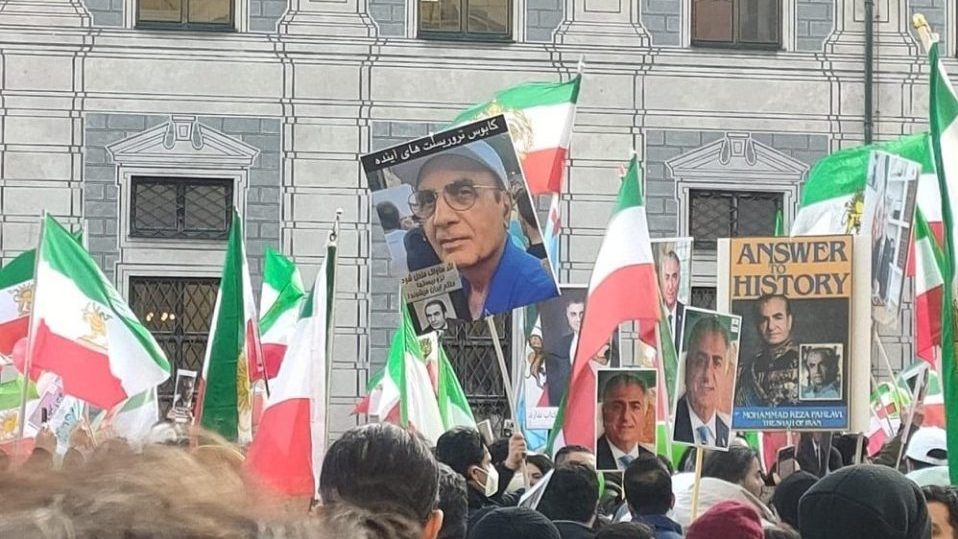
Later that year, Manoto TV broadcast a five-part program centered on Sabeti’s account of SAVAK and the Shah era. His portrait appeared at monarchist gatherings, while SAVAK flags, emblems, and supportive slogans became increasingly visible at rallies associated with Reza Pahlavi. An August 2025 federal court order noted the plaintiffs’ allegation that Sabeti’s public reappearance and the documentary first gave them the opportunity to consider pursuing their claims.
Sabeti’s ties to Reza Pahlavi’s political circle also predate his recent public reemergence. A 2006 New Yorker profile reported that Pahlavi had “long been surrounded by a small clique of his father’s loyalists” and, in the same passage, identified Parviz Sabeti, the former SAVAK official responsible for combating political opposition. Sabeti was among the influential Shah-era figures who operated behind the scenes around Pahlavi, even without holding a publicly defined position. (The New Yorker)
Iran’s Democratic Future Points Beyond Monarchy and Theocracy
The issue therefore extends beyond one former SAVAK senior official. The Shah maintained his despotic hereditary rule backed by SAVAK. The ruling clerical regime replaced it with absolute religious rule, the IRGC, the Ministry of Intelligence, political prisons, executions, and repression. Different ideologies produced the same fundamental denial of popular sovereignty: neither system allowed Iranians to freely choose and remove their rulers.
“The choice facing Iran is not between crown and turban,” Alireza Jafarzadeh, Deputy Director of the NCRI’s Washington office, said. “Iranians do not have to choose between the dictatorship that SAVAK defended and the theocracy that the IRGC defends today. Sovereignty belongs to the people—not to a hereditary monarch and not to an unelected supreme religious authority.”
That democratic demarcation is reflected in Maryam Rajavi’s Ten-Point Plan, which calls for universal suffrage, political pluralism, gender equality, separation of religion and state, abolition of the death penalty, and a democratic, secular, and non-nuclear republic.
“The alternative to the ruling regime is not restoration,” Jafarzadeh added. “It is democratic transition. ‘Neither monarchy nor theocracy’ is not a slogan about the past. It is the political demarcation that protects Iran’s democratic future.”
The Florida court will determine the Sabeti case on evidence and law. But the history returning to an American courtroom underscores a larger lesson: Iran’s path to freedom requires accountability for repression—whether committed in defense of a crown or a theocracy—and a decisive democratic break with both.
About the Iranian Resistance
The National Council of Resistance of Iran (NCRI) is a coalition advocating a democratic, secular republic in Iran. Maryam Rajavi, the NCRI’s President-elect for the transitional period, has outlined a Ten-Point Plan for a future democratic Iran. The People’s Mojahedin Organization of Iran (PMOI), also known as the Mujahedin-e Khalq (MEK), is the NCRI’s principal organized movement.