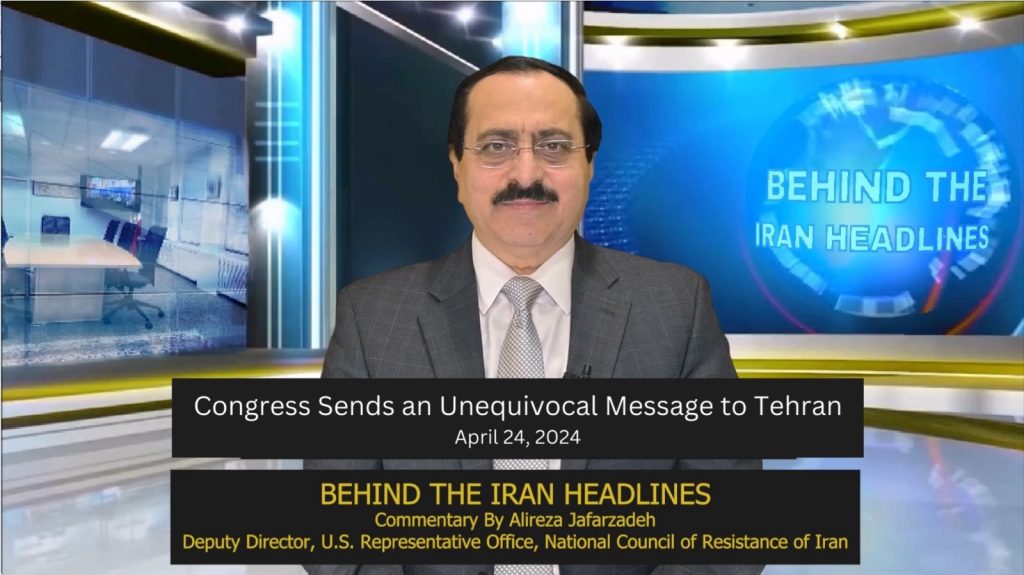
BEHIND THE IRAN HEADLINES Series, April 24, 2024, Alireza Jafarzadeh, NCRI-US Deputy Director
The foreign aid bill, which includes six bills that directly oppose the Iranian regime, was just passed in the Senate after it passed the House last week and is now sent to the President to be signed into law.
These provisions call for stringent sanctions and other punitive measures to counter Tehran’s human rights violations, sponsorship of terrorism, nuclear program, missile and drone program, and other malign and destabilizing conducts.
If signed into law and implemented, these provisions as a whole would represent a significant step forward in transforming the U.S. policy on Iran to benefit the Iranian people’s Resistance to end the theocratic rule in Iran.
The ‘‘Stop Harboring Iranian Petroleum Act,’’ also known as the “SHIP Act,” aims to reduce the Iranian regime’s revenue from oil exports, which funds terrorism in the region.
The “Fight and Combat Rampant Iranian Missile Exports Act,” also known as the “Fight CRIME Act,” aims to hinder Tehran’s development and proliferation of ballistic missiles and drones.
The “Mahsa Amini Human Rights and Security Accountability Act,” also known as the “MAHSA Act,” highlights the role of Ebrahim Raisi as someone who “has supported the recent crackdown on protestors and is a rights violator himself, having served on a ‘death commission’ in 1988 that led to the execution of several thousand political prisoners in Iran.” This act sanctions Tehran’s officials, including Khamenei and Raisi, and their offices for human rights abuses and support for terrorism.
The “No Technology for Terror Act” makes permanent existing U.S. export control restrictions that prohibit the transfer of American-made technology to the Iranian regime used to build drones and missiles.
The “Holding Iranian Leaders Accountable Act” aims to increase transparency regarding the Iran regime leaders’ finances.
The “Iran-China Energy Sanctions Act of 2023” aims to limit the purchase of the Iranian regime’s petroleum or petroleum products.
On April 16, the bipartisan House resolution H.Res. 1148, with 145 original co-sponsors, was introduced. It “recognizes the rights of the Iranian people and their struggle to establish a democratic, secular, and nonnuclear Republic of Iran.”
The U.S. Congress needs to continue sending an unequivocal message, backed by decisive measures, to Iran’s theocratic regime and its most determined adversary, the Iranian people.