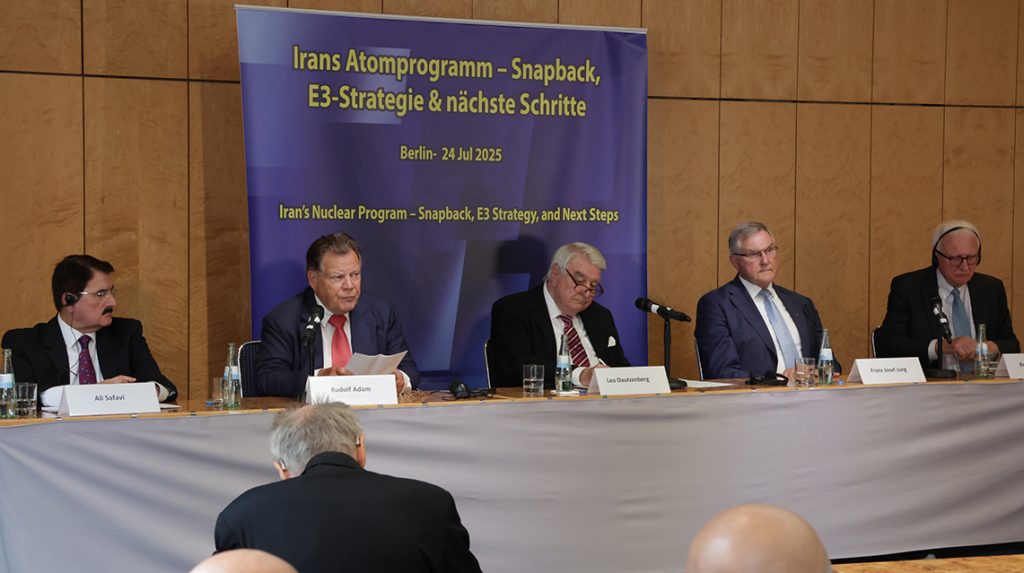
Berlin, 24 July 2025 – In a conference in the German capital and organized by the Committee in Solidarity with a Free Iran (DSFI) former senior German and US governmental officials, lawmakers, and NCRI representatives spoke on the need for firmness by Europe on the eve of the E3 negotiations with the Iranian regime in Istanbul.
Mr. Leo Dautzenbrug, former member of the Bundestag for the CDU and Chairman of the German Solidarity Committee for a Free Iran moderated the conference, entitled “Iran’s Nuclear Program – Snapback, E3 Strategy, and Next Steps,” moderated the conference, which featured Dr. Franz J. Jung, former German Defense Minister, Amb. Robert Joseph, former Undersecretary for Arms Control and International Security, Dr. Rudolf Adam, a senior diplomat, former President of the Federal Academy for Security Policy and former Vice President of the Federal Intelligence Service; and Ali Safavi, a member of the Foreign Affairs Committee of the National Council of Resistance of Iran (NCRI).
In his opening remarks, Mr. Dautzenbrug said: “Today’s conference takes place at an extremely critical moment. The window for activating the snapback mechanism is rapidly closing. The question of whether the European states should act—and what is politically at stake—concerns not only the region but the security of Europe and the world….. Together, we aim to outline the strategic and political options for Europe—at a time that is of critical importance for international security.”
In his remarks, Dr. Jung said, “The crucial question is: What instruments does Europe have to address this? Are there alternatives to military intervention? Fortunately, yes—namely, the so-called snapback mechanism. Why is this tool so vital? Because it is the strongest and perhaps the last civil means of preventing a nuclear-armed Iran. If we do not act today, tomorrow may be too late—and military escalation could follow.
“The snapback mechanism is a powerful tool to confront the nuclear ambitions of a regime openly pursuing the bomb,” Dr. Jung said, adding, “We must not waste time on fruitless negotiations with a regime that respects neither laws nor international obligations. Iran must be compelled to respect international law. That is why: the sooner the snapback is triggered, the better…. Let me be clear: Sanctions alone are not enough…. The real solution lies in changing the regime itself. This is what Maryam Rajavi, the president of Iran’s democratic opposition, has rightly called the “third option”: Neither appeasement nor war, but change from within—by the Iranian people and by an organized resistance that has fought for freedom and democracy for years…. Europe must finally recognize and support the organized and democratic resistance in Iran, represented by the National Council of Resistance, and stand with the freedom fighters and the Iranian people—instead of continuing to negotiate with human rights violators.”
Speaking about the futility of continued negotiations, Amb. Jospeh underscored, “Negotiations with the Iranian regime will get nowhere. 20—plus years of negotiation have not had positive results. They have only given the regime valuable time it needed to advance its nuclear weapons program and its ballistic missile project, to the point, where it is regional and global international peace and security. So, the E3 must trigger the snapback mechanism, reinstate the six UN Security Council resolutions, and demand the full dismantlement of Iran’s nuclear weapons program. The most viable and effective solution, however, is regime change by the Iranian people and the organized Resistance. Europe must recognize the right of the Iranian people to self-determination free of all form of dictatorship. The west is not a prisoner to the false dichotomy of negotiations and war. There is a third option, investing in the Iranian people and the organized resistance, which has been the missing link in western policy toward Iran. This is a win-win solution.”
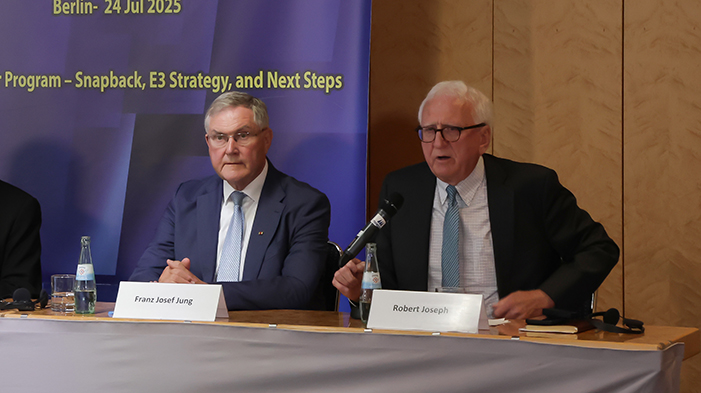
Dr. Adam was the next speaker, who said in part: “The Ayatollahs would be naïve and childish if they were to abandon now what they have pursued for over 30 years. The West now faces three options: It can continue to rely on agreements and contractual sanctions. Arguably, the snapback mechanism of the JCPOA is the best available means for quick and decisive action… Such an approach might increase pressure in the short term, but it cannot provide long-term security. Financial resources are not lacking. The expertise remains available. And political determination—especially after last month’s existential threat—is stronger than ever. Thus, the three essential requirements for building a nuclear bomb and the necessary delivery systems remain unchanged…. Anyone who wants to end the nuclear program must end the rule of the Ayatollahs. Such a change of government cannot be imposed from outside. Change must come from within, supported and welcomed by a majority of the people…. Only a change of government can guarantee that Iran will end its support for groups like Hamas, Hezbollah, or the Houthis. Only a new government can put a stop to the daily murder of dissidents. The NCRI presents itself as a political alternative to the existing order in Iran. Thus, there is a force ready to fill the power vacuum after the fall of the current regime. With its 10-point plan, the NCRI has devised a credible and convincing alternative to the present regime. It is time to turn words into deeds.
The final speaker Ali Safavi emphasized, “For over thirty years, the Iranian regime has operated on three pillars: denial, deception, and duplicity. Not just about its nuclear program—but about every promise it has made to the international community. I want to spotlight the regime’s consistent and calculated dishonesty. Because this isn’t just a nuclear issue—it’s a credibility crisis. In 2003, the mullahs signed the Tehran Declaration. In 2004, the Paris Agreement. In 2005, it claimed to suspend enrichment. But behind the scenes, it was doing the opposite. It hid centrifuges. Expanded covert operations. Built underground sites. And who exposed these violations? Not the IAEA. Not Western intelligence. But the NCRI and Iranian resistance movement. The era of talks without consequences is over. Tehran’s history of deception demands accountability. The regime’s playbook is clear: Agree to temporary concessions. Win sanctions relief. Then violate every commitment once the pressure fades. The international community must act. The E3 must trigger the snapback mechanism. Reinstate all six UN Security Council resolutions. Impose real, comprehensive sanctions. Demand zero enrichment. Demand total dismantlement of the regime’s nuclear infrastructure. Anything less is a green light for further violations. The world stands at a crossroads. The world must act—decisively, urgently, and with resolve?”