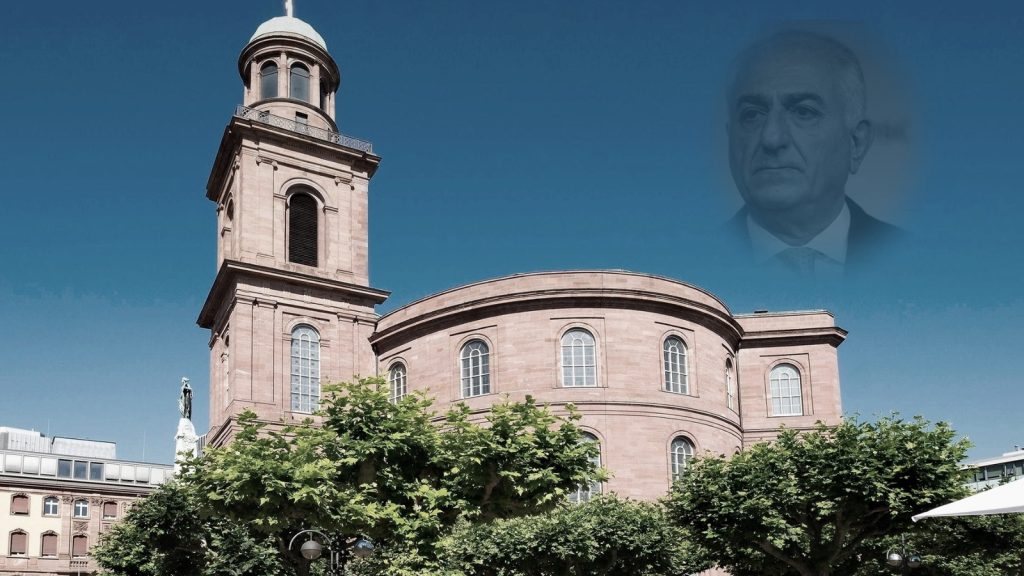
By entrusting its 2026 Freedom Prize for the Iranian people to an unelected and deeply divisive exile politician, Germany’s Friedrich Naumann Foundation risks turning an honor for a nation’s struggle into an exercise in manufactured political legitimacy.
By NCRI-US Editorial Team – October 17, 2026
Germany’s Friedrich Naumann Foundation for Freedom‘s decision to award its 2026 Freedom Prize to the Iranian people should have been an uncontroversial tribute to extraordinary courage.
For years, Iranians have confronted a ruling regime that answers demand for freedom with bullets, prisons, torture, and executions. Honoring that struggle in Frankfurt’s historic Paulskirche on November 7 could have sent an important message of solidarity.
Instead, the FDP-affiliated Foundation has created a political controversy of its own making by appointing Reza Pahlavi, son of Iran’s deposed Shah, to receive the prize “in trust” on behalf of the Iranian people.
The contradiction is difficult to miss.
The Foundation’s own announcement emphasizes that it is deliberately awarding the prize to the Iranian people rather than to an individual. Yet it then appoints an individual whose only relevance to Iran is his deposed father, whom Iranians have rejected, to represent them, describes him as an “opposition leader,” and goes so far as to claim that he is probably the principal political identification figure for a majority of Iranians.
No democratic process produced that conclusion. The issue, therefore, is not simply who walks onto the stage in Frankfurt to collect a plaque. The question is whether an institution dedicated to liberal democracy should appoint a political representative for a people struggling to reclaim the right to choose their representatives.
A German Backlash the Foundation Should Not Ignore
The Foundation’s decision has already generated an unusually broad backlash inside Germany.
In an open letter, 71 prominent figures from German political, judicial, diplomatic, academic, and cultural life urged the Foundation to reconsider. The initiative was led by Joachim Rücker, a former president of the UN Human Rights Council. Signatories included former Bundestag President Wolfgang Thierse; former federal ministers Brigitte Zypries and Peter Altmaier; former Constitutional Court judge Susanne Baer; former UN special rapporteur Heiner Bielefeldt; and former senior diplomats, parliamentarians, and prominent jurists.
The Frankfurter Rundschau reported extensively on the protest.
Their objection goes to the heart of the matter. The signatories welcomed honoring the Iranian people but warned that letting Pahlavi accept the award in their name could confer “representative legitimacy” on a deeply polarizing figure with no democratic mandate to speak for them.
The controversy has reached Frankfurt’s city politics as well. Local political figures have questioned why Pahlavi should be elevated as a representative of Iran’s freedom movement and warned against allowing the Paulskirche, a powerful symbol of German democratic history, to become a venue for legitimizing monarchical political claims.
Former Bundestag member Martin Patzelt subsequently challenged the Foundation’s defense in an open response, asking the essential question: Who gave Reza Pahlavi the democratic legitimacy to receive an award in the name of the Iranian people?
The backlash has also spread across the Iranian diaspora. In an open letter, 306 Iranian associations and communities—including 70 in Germany—protested the Foundation’s decision to have Reza Pahlavi receive the Freedom Prize in the name of the Iranian people. The signatories said the move contradicts the democratic principles the award is meant to uphold, ignores Iranians who reject both the ruling theocracy and hereditary monarchy, and asked the Foundation to explain why it has disregarded their objections.
The Foundation has not yet provided a convincing answer.
The Symbolism Is Particularly Troubling in Germany
Germany has its own history with the Pahlavi monarchy.
During Shah Mohammad Reza Pahlavi’s 1967 visit to West Berlin, German and Iranian students protested dictatorship and political repression in Iran. Supporters of the Shah and members associated with his security apparatus, the SAVAK, attacked demonstrators. German student Benno Ohnesorg was shot and killed by a West Berlin police officer during the protests, an event that became a watershed in postwar German political history.
The 71 German signatories explicitly invoked that history. They also pointed to renewed public displays of SAVAK symbols among some Pahlavi supporters.
That is not an abstract historical concern.
Earlier this year, The Guardian documented the open glorification of SAVAK by pro-Pahlavi activists, including banners and clothing bearing the insignia of the Shah’s notorious secret police. The newspaper also reported a banner displayed at a Munich rally proclaiming “one nation, one flag, one leader”—language critics noted carried unmistakably authoritarian echoes.
SAVAK was not an institution associated with pluralism or democratic tolerance. It became synonymous with surveillance, imprisonment and torture of political opponents.
A political campaign seeking recognition as a democratic alternative cannot simply be judged by carefully constructed English-language statements about democracy. Actions, political culture and the behavior repeatedly tolerated or generated around a movement also matter.
Violence and Intimidation Cannot Simply Be Explained Away
That record has become increasingly difficult to overlook.
In May, The Guardian reported on intimidation and clashes involving Pahlavi supporters in Britain. One prominent pro-Pahlavi rapper was filmed mimicking gunfire while naming the IRGC, Basij and the People’s Mojahedin Organization of Iran (PMOI), also known as the Mujahedin-e Khalq (MEK), as targets.
Reuters subsequently conducted an extensive investigation into Pahlavi’s political campaign. It documented harassment and assaults involving supporters in several countries and reported growing concern even among some former allies and donors about aggressive behavior within his movement.
The pattern continued in New York.
On September 22, during a large demonstration organized by supporters of the Iranian Resistance near United Nations headquarters, Reza Ebrahimi, a Pahlavi supporter, attacked a young MEK supporter, injuring his face before New York police arrested Ebrahimi. Getty Images photographers captured the assault, the bloodied victim and the attacker being taken into police custody. The NCRI-US documented the incident.
The State of New York subsequently filed five criminal assault charges against Ebrahimi, a staunch Pahlavi supporter who has repeatedly appeared at pro-Pahlavi events and has been publicly embraced and warmly received by Reza Pahlavi himself, clear indications that he was not simply an anonymous individual on the fringes of the monarchist camp.
The significance of the episode therefore extends beyond the actions of a single rallygoer: it adds to a broader pattern in which prominent Pahlavi supporters have used intimidation and, at times, physical violence against other Iranian dissidents while presenting themselves as champions of democracy and tolerance.
This was not an exchange of harsh political rhetoric on social media. It was physical violence against another Iranian dissident at an anti-regime rally.
The Foundation has argued that Pahlavi cannot be held responsible for every statement, banner or action of individual supporters.
But when intimidation, threats against journalists, attacks on rival opposition activists, SAVAK imagery and authoritarian slogans recur across countries and over time, they demonstrate a trend and become relevant evidence about the political culture developing around a campaign that is simultaneously asking the democratic world to recognize its leader as Iran’s representative.
Visibility Abroad Is Not a Democratic Mandate at Home
The Naumann Foundation’s decision also illustrates a wider problem surrounding Pahlavi’s political visibility: the repeated conversion of foreign visibility into presumed Iranian legitimacy.
The distinction between visibility and organization matters.
A lengthy Reuters investigation in July found that claims regarding Pahlavi’s extensive networks inside Iran were difficult to verify independently and documented repeated failures to unify opposition forces around his leadership.
During the January uprising, grand claims were made about personnel within the regime’s military and security structures being prepared to break ranks. When the decisive test came and the IRGC and other security forces massacred protesters, the promised mass defections did not materialize.
Political claims should ultimately be judged by results, not repetition.
This is precisely why the comparison with Ahmed Chalabi has gained currency well beyond Iranian opposition circles.
In January, TIME explicitly raised the Chalabi analogy, recalling the Iraqi exile whose stature in Washington far exceeded his demonstrated political base inside Iraq. The comparison is not that Iran and Iraq are identical, nor that every outside supporter of Pahlavi participates in some coordinated conspiracy.
The more important parallel is a political process: an exile figure receives extraordinary foreign access and attention; assertions about domestic popularity and organizational reach are repeated without adequate independent verification; foreign political circles increasingly treat that visibility as evidence of leadership; and each new platform is then cited to justify the next. (TIME)
Call it “Chalabi 2.0” or simply manufactured legitimacy. The danger in the process is the same: outsiders begin choosing the interlocutor before the people concerned have had the opportunity to choose for themselves.
The Friedrich Naumann Foundation’s decision is a textbook example of how that happens.
Even Tehran Sees the Utility of a Weak, Divisive Alternative
Perhaps one of the most revealing assessments of the monarchist current has come from the Iranian regime’s own media.
In February 2025, the state-run newspaper Vatan-e Emrouz described monarchism as a weak and rootless movement that could actually contribute to the survival of the ruling system. An analysis of the article noted the striking admission that a weak opponent can be politically useful precisely because it divides and discredits the broader opposition without posing a serious challenge to those in power.
The calculation is not difficult to understand.
For Tehran, an opposition personality who absorbs enormous international attention while failing to organize a comparable force inside Iran can be useful. A monarchist current that redirects political energy toward attacking other regime opponents can be useful. The revival of SAVAK imagery is useful to a theocracy that desperately wants Iranians to believe their only alternatives are the dictatorship of the turban or the dictatorship of the crown.
A divided opposition movement is unquestionably useful to a regime whose greatest fear is an organized, determined, democratic force capable of mobilizing society against it.
The Iranian People Do Not Need a Manufactured Custodian
There is something fundamentally backward about the Foundation’s arrangement.
It says the prize belongs to the Iranian people and that Pahlavi will hold it until it can someday be transferred to Iran’s freely elected representatives.
But if freely elected representatives are the legitimate recipients, why should an unelected political claimant – whose principal tie to Iran is his defense of his father’s deposed dictatorship and his own longstanding claim to the throne, which he asserted in 1980, calling himself “Reza Shah II,” as widely reported by The Washington Post at the time – be inserted between the Iranian people and those future representatives at all?
The Foundation could honor political prisoners. It could recognize the families of executed protesters. It could retain the award itself until Iran is free.
What it should not do is use the prestige of a German democratic institution to manufacture the appearance of a national mandate that no free Iranian election has granted.
The struggle in Iran is not a contest to replace one form of authoritarian rule with another. For more than a century, Iranians have struggled for sovereignty, freedom and the right to determine their political future themselves.
The Friedrich Naumann Foundation was right to honor that struggle. It was wrong to choose its representative, and even worse to align the nation with a past dictatorship.