By Hollie McKay, INTERNATIONAL POLICY DIGEST, April 27, 2025
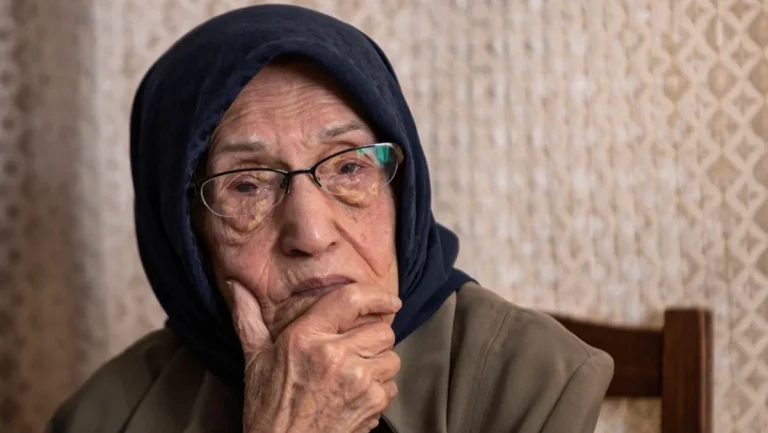
Fifty years later, Iranian activist Aziz Rezaee still bears the scars of torture on the bottoms of her frail feet. Yet, the 96-year-old’s years of abuse and political imprisonment stemmed not from the iron fist of the mullahs but from their predecessor, Mohammad Reza Pahlavi, revealing the underbelly of an Iranian epoch often romanticized by history as a bastion of freedom and progress.
“Iran was a beautiful place – but only for the very rich, not for the vast majority of Iranians, and that was the story of the Revolution,” Aziz tells me from her small apartment on the periphery of Paris. “And there was only one party – there could be no opposition.”
Born Zahra Norowzi in 1929 in Tehran, Aziz – a better-known moniker that translates to “dear” –married and gave birth to the first of nine children at age fourteen, a son named Hassan, who succumbed to pneumonia shortly after childbirth.
However, such tragedy only marked the beginning of what was to come.
Her nation’s heartache, Rezaee asserts, took hold in the early 1950s with the Western-engineered overthrow of Mohammad Mosaddegh, Iran’s first democratically elected prime minister, who nationalized Iran’s oil industry. This act, along with other nationalist policies and Western fears of communism, led to a 1953 CIA and MI6-backed coup, which toppled Mosaddegh and restored the Shah as the sole power rather than a symbolic leader.
“Then my son Ahmad, in high school, became engaged in (opposition) politics,” Aziz recalled. “And that is when our lives changed.”
In the years that followed, Aziz would lose a total of three sons and two daughters – four under the Shah and one under the Ayatollah. Aziz also lost two sons-in-law under the oppressive rule of the Shah and the Ayatollah.
Their transgression? Belonging to Iran’s main democratic opposition movement, an opposition outfit formed in 1965. Perhaps the most significant transgression of the Shah’s time was the creation of the SAVAK, a secret police force, which was formed after he consolidated power. This robust internal security force brutally cracked down on those perceived as defying formal or informal government policies.
After months of torture and an eventual escape from prison, Aziz’s son Reza was killed on June 15, 1973, amid a street clash with the SAVAK, and another son Ahmad was slain under similar circumstances eighteen months earlier. In 1975, her daughter Sedigheh was also gunned down by the SAVAK as she tried to evade arrest. In many ways, Aziz acknowledged, it was easier to cope with the knowledge that her children would never again have to weather barbarity under the SAVAK’s fist.
As opposition figures will attest, from 1963 to 1979, the Shah’s reign was characterized by strict measures to suppress political dissent. Thousands of political activists were tortured or executed, and reforms like women’s suffrage alienated traditional Muslims.