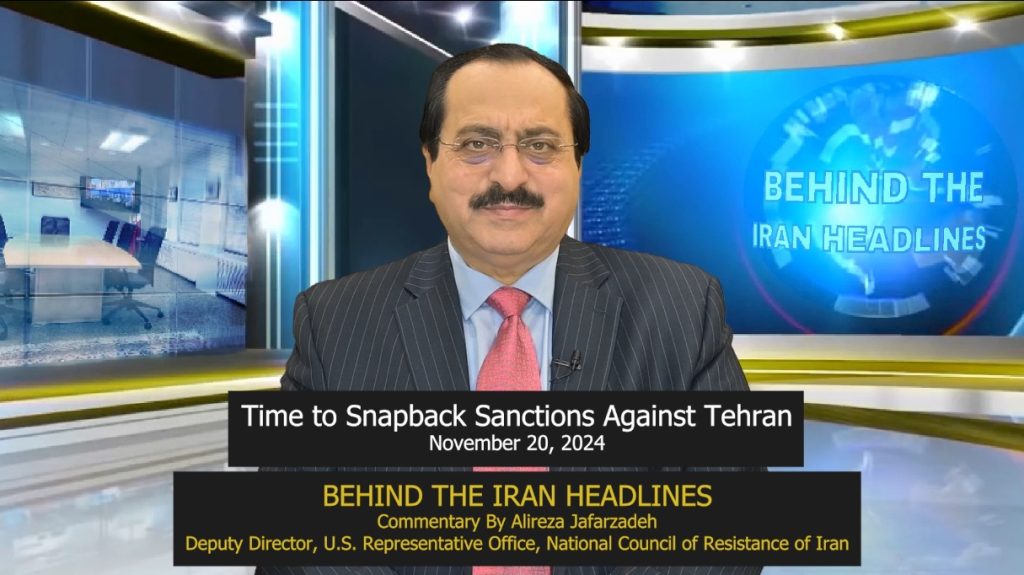
BEHIND THE IRAN HEADLINES Series, November 21, 2024, Alireza Jafarzadeh, NCRI-US Deputy Director
Iranian officials’ recent statements underscore a dangerous escalation in the regime’s nuclear posture, as highlighted by the recent remarks of Foreign Minister Abbas Araqchi and Mohammad Javad Larijani, a senior figure and close ally of Supreme Leader Ali Khamenei.
These developments reflect a pattern of defiance, duplicity, and bluster that demands a decisive response from the international community. It is time to activate the JCPOA’s snapback mechanism at the United Nations Security Council.
Tehran’s consistent obstruction of International Atomic Energy Agency (IAEA) inspections and its continued enrichment of uranium to 60% — a step dangerously close to weapons-grade — are clear violations of international norms.
Based on the new IAEA quarterly report, Tehran could produce enough fissile material or weapons-grade uranium for one bomb in less than a week and ten nuclear weapons in one month. Yet Tehran is making meaningless last-minute promises to avoid sanctions before the IAEA Board of Governors is scheduled to vote on a resolution condemning the regime later this week.
While Tehran claims its nuclear program is peaceful, its rhetoric and actions tell a different story. Araqchi’s threats of retaliation and Larijani’s boast of achieving “military nuclear readiness” within 24 hours reveal an overt shift toward nuclear blackmail as a means of staving off growing international pressure.
The regime’s aggressive posture, including explicit calls for nuclear weapons development, exposes its true intentions. Officials like Kamal Kharrazi, an advisor to Khamenei, have openly advocated for nuclear weapons as a means of achieving “regional balance,” further destabilizing an already volatile Middle East.
The regime’s nuclear brinkmanship coincides with its mounting domestic and international challenges. An economy crippled by sanctions, growing unrest at home, and the potential return of the “maximum pressure” policy create a precarious situation for Tehran. The regime’s desperation is evident in its increasingly aggressive rhetoric, which aims to intimidate Western capitals and deter further sanctions and scrutiny.
The international community must act decisively. A strong resolution at the upcoming IAEA Board of Governors meeting is a necessary step. Additionally, activating the JCPOA snapback mechanism would signal that Tehran’s violations will not go unanswered.
Beyond sanctions, global powers must support the Iranian people’s aspirations for regime change, recognizing that sustainable peace in the region hinges on the establishment of a democratic, secular, non-nuclear republic in Iran.