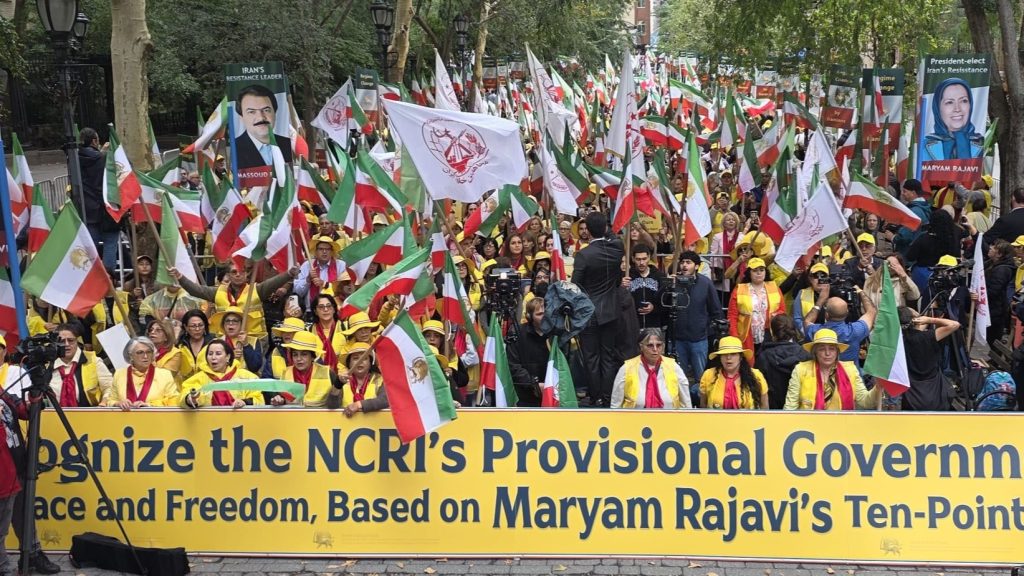
NEW YORK, September 22, 2026 – Several thousand Iranians and supporters of the National Council of Resistance of Iran (NCRI) gathered outside United Nations headquarters on Tuesday, calling for an end to political executions in Iran and international recognition of the Iranian people’s struggle for a democratic republic.
The demonstration at Dag Hammarskjold Plaza brought together participants from across the United States and beyond during the opening of the 81st session of the UN General Assembly. Many had faced flight cancellations and serious travel disruptions but nevertheless reached New York by alternative flights, trains, buses, and cars. Their persistence added to the atmosphere of urgency and resolve as world leaders assembled only steps away.
There was a remarkable presence of young people in the crowd. Many waved Iran’s Lion and Sun-emblazoned flag, while others held photographs of victims of the clerical regime or carried portraits of the Resistance’s leadership, Massoud and Maryam Rajavi. Their participation gave the gathering a striking generational dimension and underscored its message that Iran’s future belongs to its people.
One of the most prominent chants was, “No to the oppressor, be it the Shah or the Supreme Leader.” Repeated across the plaza, it rejected dictatorship in both its monarchical and religious forms and affirmed the demonstrators’ demand for a democratic republic. Participants also voiced support for Rajavi’s Ten-Point Plan and insisted that Iran’s future must be decided neither by the ruling theocracy nor by foreign military intervention, but by the Iranian people and their organized resistance.
Rajavi’s address to the rally, delivered online, formed the political centerpiece of the gathering. Speaking directly to world leaders, she said the presence at the United Nations of officials responsible for crimes against humanity and genocide made a mockery of human rights, peace, and justice.
“Those whose hands are stained with the blood of hundreds of thousands of innocent people in Iran and across the region must be expelled from the United Nations,” Rajavi declared. “Iran’s seat belongs to the Iranian people and their legitimate Resistance for peace, freedom, and a democratic republic.”
She warned that repression, executions, terrorism, and warmongering would continue for as long as the present regime remained in power. The solution, she said, was democratic change brought about by the Iranian people and their organized resistance, adding that such change was within reach.
Rajavi described the determination visible inside Iran as the defining message of the moment. The Iranian people, she said, were resolved to overthrow the ruling religious fascism at any cost. She presented the expanding activities of the Resistance Units – active across all 31 provinces – as an expression of that determination and as evidence that the demand for change had acquired an organized force inside the country.
Her message linked the struggle for freedom inside Iran to the international community’s responsibilities. Rajavi urged governments to end policies that grant legitimacy and diplomatic space to Tehran while its authorities execute dissidents, suppress protesters, and export violence. She called for accountability for crimes against humanity and for recognition of the Iranian people’s right to resist dictatorship.
Rajavi cited reports by the United Nations Special Rapporteur, Amnesty International, and the International Fact-Finding Mission concerning past massacres and the suppression of recent uprisings. She warned that international inaction over grave human rights violations had encouraged the regime to believe it could also pursue its nuclear program and foment conflict across the region without consequences. She called on the international community to recognize the Iranian people’s right to overthrow the regime and the right of Resistance Units and the National Liberation Army to confront the Islamic Revolutionary Guard Corps.
At the heart of Rajavi’s alternative is the Ten-Point Plan, which calls for a republic founded on universal suffrage, free elections, political pluralism, freedom of expression and assembly, separation of religion and state, equality between women and men, autonomy and equal rights for Iran’s ethnic communities, abolition of the death penalty, an independent judiciary, and a non-nuclear Iran living in peace with its neighbors. The NCRI has pledged that, following the regime’s overthrow, a provisional government would organize elections for a constituent assembly within six months and transfer authority to the people’s elected representatives.
The demonstration took place amid growing alarm over executions in Iran. According to rally organizers, at least 40 political dissidents – many associated with the People’s Mojahedin Organization of Iran (MEK) or the January 2026 uprising – have been executed since mid-March, while more than 100 political prisoners remain under sentence of death. Large outdoor displays and photographs near the rally commemorated victims of repression and highlighted resistance activities across Iran.
Several prominent former American officials addressed the gathering. Retired General Keith Kellogg, former US Special Presidential Envoy for Ukraine, told participants that their presence sent “a message of hope and resistance” both to the Iranian people and to international leaders meeting at the United Nations.
Kellogg said the NCRI offered a blueprint for future governance based on freedom and described Resistance Units inside Iran as an engine of change. While military action and sanctions had weakened the regime, he argued, neither could by itself produce democratic transformation. “That change is dependent upon the people of Iran,” he said, urging support for a transition to a secular, non-nuclear republic and free elections.
Retired General Wesley Clark, the former Supreme Allied Commander Europe, said Tehran’s representatives should not be accorded legitimacy at the United Nations while the regime denied its own citizens fundamental rights, sponsored terrorism, and executed people for their political beliefs.
Former US Ambassador to Denmark Carla Sands likewise argued that lasting change could come only from an indigenous force. Military pressure might weaken Tehran, she said, but the enduring solution lay in supporting the Iranian people and their organized resistance as they pursued change from within.
Sands praised the MEK’s 61-year struggle against both the Shah’s dictatorship and the clerical regime, paying particular tribute to the role of women in the movement’s leadership. She said the succession of women serving as the organization’s secretaries general since 1989 presented a stark contrast with the misogyny of the ruling theocracy.
She also highlighted Rajavi’s role in shaping a democratic alternative, describing her as a leader whose political vision had challenged historic barriers. A free, democratic, secular, and non-nuclear Iran, Sands said, would not only secure the rights of Iranians but would also end a major source of terrorism, hostage-taking, nuclear proliferation, and regional instability.
Throughout the gathering, placards expressed solidarity with political prisoners, families of those executed, and Resistance Units operating inside Iran. Together with the flags, portraits, and chants, they transformed the plaza into a vivid display of opposition to every form of dictatorship.
The demonstration’s message converged around Rajavi’s central assertion: the regime’s continuation means continued repression and conflict, while the viable path to peace is democratic change by the Iranian people. As delegates entered the United Nations, the crowd outside sought to ensure that Iran’s rulers would not be mistaken for Iran’s people – and that the alternative represented by Rajavi and the organized resistance would be heard.