Alireza Jafarzadeh, Deputy director, U.S. Office, National Council of Resistance of Iran (NCRI), Washington
November 7, 2025
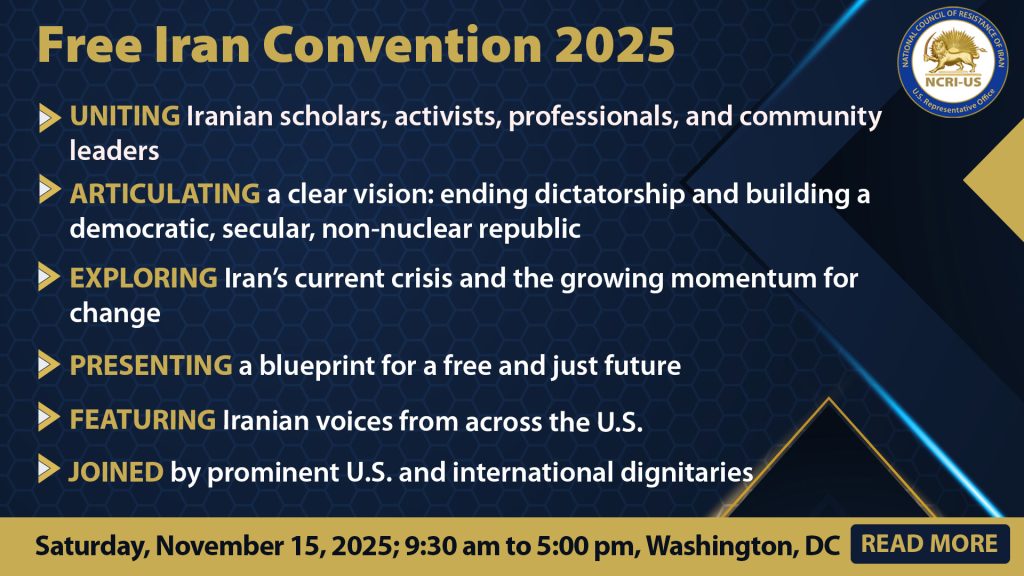
For nearly four decades, Iran’s political future has been framed in Washington as a choice between confrontation with the ruling theocracy or accommodation with it. Yet neither approach has delivered stability, nor has either addressed the deeper reality inside Iran: the overwhelming desire among Iranians for meaningful change. The Free Iran Convention 2025 represents a critical turning point in how Iran’s future should be understood in U.S. policy, international diplomacy, and global security discussions.
The event is not merely a gathering, nor a symbolic appeal for some superficial reform. It is a structured presentation of a political reality that has become increasingly clear: meaningful change in Iran is only possible with the end of clerical rule. This conclusion is not ideological. It is drawn from the lived experience of Iranians themselves, reflected in successive nationwide uprisings over the past several years. These uprisings, spanning urban centers, ethnic provinces, industrial towns, and student campuses, have demonstrated that calls for reform have lost all legitimacy among the population. What remains is a unified demand for democratic transformation and the overthrow of the ruling theocracy in its entirety.
At the center of this transformation is a nationwide organized Resistance movement with a growing presence inside Iran. The Resistance Units, composed increasingly of women and young Iranians, have emerged as a decentralized yet coordinated force that undermines the regime’s authority, challenges its suppression apparatus, and sustains the spirit of political defiance. The Free Iran Convention highlights not only their existence, but the strategic coherence guiding their actions. This is not a spontaneous protest; it is an organized struggle with a clear objective.
Equally significant is the Convention’s focus on the question that has long paralyzed international policymakers: what happens the day after the regime falls? The event highlights the National Council of Resistance of Iran (NCRI) as a viable democratic alternative, with a defined political platform, broad social legitimacy among large segments of the Iranian diaspora, and international recognition.
The NCRI’s commitment to forming a provisional government after the fall of clerical rule, followed by free and fair elections, offers an orderly, peaceful, and inclusive mechanism for national transition. This matters deeply immensely as concerns about instability, fragmentation, or power vacuums have historically contributed to muting support for democratic change in Iran.
The Free Iran Convention highlights the solution to the head of the snake of war and terror in the region by demonstrating that the Iranian people are not seeking chaos or instability; they are seeking self-governance, rule of law, equality for women, separation of religion and state, and a peaceful place for an independent Iran in the international system.
The significance of this Convention is that it clearly and confidently states that change is already underway for those who have paid the price for decades. The role of the international community now is to recognize it, embrace it, and stand with the Iranian people as they shape their democratic future.