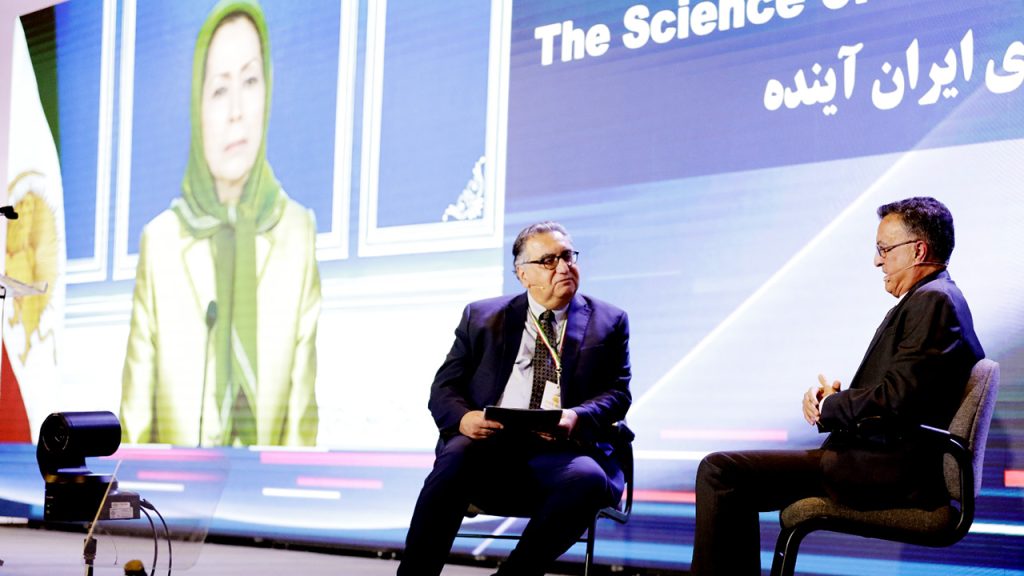
Washington, DC, November 15, 2025. The NCRI Free Iran Convention hosted a specialized session under the theme “A Meeting of Minds: Science Without Borders,” featuring Professor Morteza Gharib, the Hans W. Lippman Professor of Aeronautics and Mechanical Engineering at Caltech, and the inventor of the life-saving iStent. The interview was conducted by Dr. Mohammad H. Tasooji. Professor Gharib’s insights extended beyond his over 170 patents to address the critical link between scientific innovation and a democratic society. He analyzed how the oppressive political climate in Iran stifles creativity, leading to a massive brain drain despite the country’s top-tier intellectual potential. Emphasizing the necessity of academic freedom and free thinking to leverage Iran’s abundant human and natural capital, Professor Gharib underscored that the NCRI’s 10-point platform offers the crucial framework for a future where Iranian science can flourish. Below is the full text of their discussion.
Interview with Professor Morteza Gharib
Dr. Mohammad H. Tasooji: So, Dr. Gharib, thank you very much for accepting the invitation and being present here. I’ve always wanted to know, having 170 patents, which one is your most favorite one?
Professor Morteza Gharib: Well, first of all, thank you for inviting me and also for the gracious and kind introduction. That’s a tough question. It’s like among your children, pick up one, which one you would love more. But I have been always cognizant of issues that medicine and also technology people challenge. But in this case, medicine has been my favorite patents that I have. And among them, as you mentioned, invention for treatment of glaucoma without using any actually drops. You know, it’s a very difficult disease to treat and our invention allowed that by just an operation procedure half an hour during a cataract surgery to solve the problem forever. And right now two million people are in the world having it and we have very good results.
And the other one is my philosophy of making sure that the most advanced medical technologies and treatments are available to the masses. And as you know, at least in this country, the price and cost of treatment is very high. If you wanted to have a heart valve, for example, God forbidden, it costs between $12,000 to $30,000. So through our inventions with my team, we came up with the heart valve that instead of using animal tissues, we are using polymers. And because we cut the price from $12,000 down to $600. And right now is the final approval by FDA, but some other countries already approved it, like in India, is very popular because they have fantastic surgeons, but they cannot afford expensive heart valves coming from US. So those are my favorites. The other 160 should wait. So Dr. Adib, I know you’ve been involved in many research and scientific endeavors. You’ve been with JPL, with NASA, and many other things, and as well as AI.
Dr. Mohammad H. Tasooji: I want to see, in your opinion, how do you see the future of science, technology, engineering, especially with this artificial intelligence? How do you see the whole engineering and technology evolving with the new technology?
Professor Morteza Gharib: Well, of course, every expert has different opinion. Mine is based on, especially as it goes through AI, is that AI is a tool and depends on how we use it. So future of technology, especially engineering and medicine especially, it’s going to depend on how we use AI in order to expedite from diagnostics to treatment to using it for basically advance our progress in different areas. I think the key point that will help the engineering and science is that we do not use AI as a decision maker, but as a tool. And we be the judge what is the best way of going to approach these problems. You should remember that AI lives on information that we provided in the past. So AI is not going to create a new Picasso or new Einstein. But once we introduce it to Einstein and Picasso’s, it can try to do better or more of Picasso’s. So at the end of the day, human beings are the key to development of science and technology in the future, but better tools. And that tool is AI.
Dr. Mohammad H. Tasooji: So that echoes what Professor Tao, who is the famous mathematician at UCLA, is probably with IQ of 250. And he has the same view. He says that AI is a good copilot rather than the pilot itself. So you concur with that idea. Dr. Gharib, you were educated—I mean, got your undergraduate at University of Tehran, which is one of the best probably universities in Iran, along with the University of Sharif. And then, like me, you migrated to the United States, and you didn’t go back. First of all, I would like you to know what made you decide to come to the United States? Why did you leave the country? And then why you stayed here, why you didn’t go back?
Professor Morteza Gharib: Well… It’s a painful memory, but, you know, I’m more than glad to share with you. I think innovation and creativity cannot flourish in a society or a community that does not allow free thinking. And especially creativity can only flourish in a society or community that allows younger generation to question, to explore, and to come up with some answers for the societal issues that they’re dealing with.
And despite all the artificial so-called progress that, you know, during the Shah’s regime was in Iran, one thing was missing, and that was allowing for a democratic society that allows for the younger generation and all the generations to think freely and ask for accountability. And for that reason, many of us, especially university students, like me, did not see any future for if they wanted to go to an environment that allows them to get better and to be more effective in terms of contributing back to the society.
And all of it went back to the fact that it was not a system that was democratic and allowed for academic freedom, or to allow us to pursue our dreams in how to help our communities. So for having a breath of oxygen of Freedom, I decided to leave the country; on the other hand, many of us much better than me decided to stay and continue to fight for bringing democracy to Iran, and among them you can even now, you know, some of the leadership of MEK at that time were classmates and NCRI.
So that was a choice for me to make at that time. So how do you see the engineering talent of Iranian society, Iranian people? I, for those of you, I was doing a project and based on the 2020 census in the United States of one and a half million Iranians that live here officially. Half a million, 500,000 people have degrees of masters or PhD or more professional degrees. So definitely there’s a great pool here.
Just to add to your statistics, there are more Iranian original physicians in Canada than in Iran. This is really shameful fact. But getting back to your question, you know, every Iranian family would love their kids to go to engineering, to science, to medicine, or excel in business. We always push our kids to be better and do better. And with all the talents that we have in Iran and all this, you know, I would say, high IQ, actually, Iran ranked among the top three countries in the world with the highest IQs. Basically untapped is resources. Of course, you need to have material, and we have the material too. We are sitting on largest natural resource in the world. You can mention it from minerals to gas and oil. And just think of if you could combine them in a society that people naturally try to solve problems, try to develop technologies that can help themselves and other people. That would be almost unimaginable. We have all the parameters that is required for being successful as an advanced country in this world.
Dr. Mohammad H. Tasooji: Well, one other question that I have, and that’s maybe more for the future, is how can we attract this talent back to Iran? Just FYI, I was doing a research for NCRI, some 20 years ago, and I was looking at the list of professors at the universities in the United States of America. I didn’t have a chance to look at Europe and otherwise. There was not one single university that did not have an Iranian professor teaching there, not a single one. So based on your opinion, what should we do to pull back, to attract back this immense amount of talent that we have abroad to Iran?
Professor Morteza Gharib: Well, before answering that question, going back to your comment, it shows very clearly that if we bring the same people, same students, same talents to society that allows them to grow, what they can achieve. Of course. I mean, I was thinking, I was looking at some of the statistics. Right now, what, 10% of the chairs of electrical engineering in this country are from Iranian origin. You can imagine that, you know, there must be something good about them. But how come they couldn’t do it back in Iran?
The answer is obvious. The answer is that you need to create an environment that allows free thinking. Do not punish people for questioning. And that means that you need to have a democratic environment, a democratic government that supports its people for being innovative, creative, and help them. I think once you have that environment, people will do the job. We don’t need to tell them what to do exactly. They can solve all the problems for us. Bringing that back to Iran is a necessary condition to have a democratic, secular, and peaceful Iran Republic.
Dr. Mohammad H. Tasooji: Have you had any chance to discuss your views and whatnot with the leadership of the opposition?
Professor Morteza Gharib: Yeah, I was actually lucky enough to spend many occasions to have this discussion. And without any exaggeration, the most impressive part of my meeting was with Madam Rajavi. And she is an amazing scientist. I’m telling her in front of her, you know, the type of questions that she asked me kind of… The type of question and depth of questions, I think not the type of question, depth of questions in from AI to quantum physics to astrophysics, medicine. I said, this lady must have been studying a lot. How many hours she has per day that can actually study and ask such a deep question. Thank you very much. Anyways, you challenge me to be a better scientist. So we had good discussions and I think at the end of the day it’s obvious that you know we need to have the opportunities and create the opportunities for our younger generations and as one guys we have you know leadership that they are for science and for engineering I have no doubts that once we have that democratic Iran we are going to be in good business.
Dr. Mohammad H. Tasooji: Speaking of Madame Rajavi and her thirst for science and technology, we’ve had occasions as a member of NCRI that I had the privilege and honor of sitting with Madame Rajavi, and she always asks questions. But one of the most important thing to me is that Madam Rajavi is asking scientific questions, not only for the sake of scientific questions, but she is seeing how can I implement this in the organization to make it even more efficient, like AI and whatnot. And for me, that’s truly, truly remarkable. The focus that Madam President-elect has on the issue of bringing democracy to Iran, regime change in Iran, but also making efficient the organization that she’s leading towards Iraq. My last question to you is, although I have so many other questions that I wish I could have asked, but time is short. The question to you is, what kind of suggestion would you have for the future of Iran and the resistance?
Professor Morteza Gharib: Of course, I’m a scientist, so I only trust myself when I make scientific suggestions, but I don’t think that we need to make any suggestions. You know, we have the 10-point platform. Just follow that. I mean, it creates all the environments that you need to have, all the requirements that you need to have to fulfill everything that I mentioned. I mean, that 10 points and I studied very carefully. It’s a nice rejuvenated U.S. the original constitution. It’s just amazing that also designed for Iranians, for Iranian societies. So my only suggestion, if I may, is that let’s follow that 10 points, that those 10 points. I mean, we are going to be in good shape. Awesome. Dr. Naliz, thank you very much for the privilege. It’s quite an honor and really we.
Dr. Mohammad H. Tasooji: As an Iranian professor and engineer, scientist, it’s it’s an honor to have someone like you, you know, support the resistance and also help the humanity. So thank you very much for telling me.
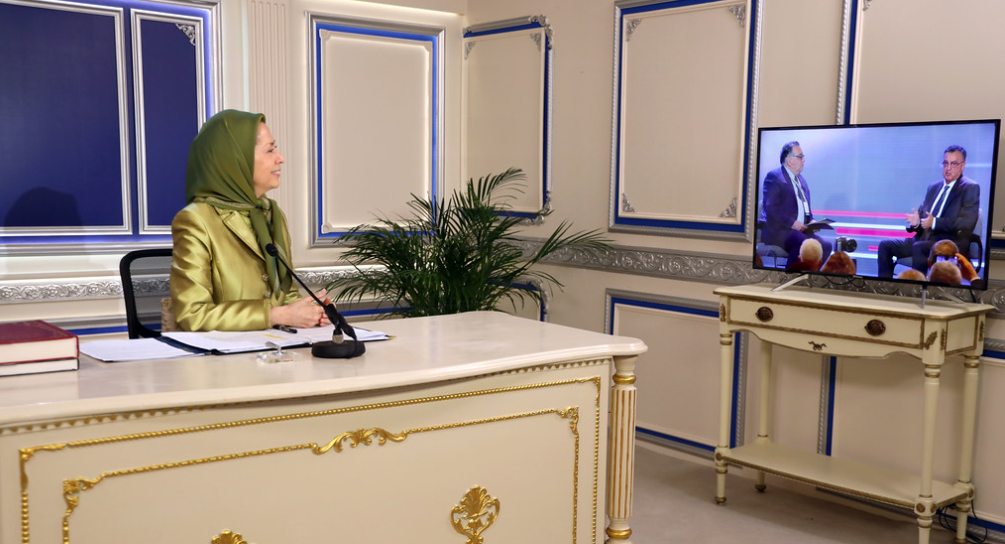
Mrs. Maryam Rajavi, President-elect, NCRI: The reality is that every time I ask you questions, it’s to be able to raise my awareness and to be able to learn from you. So that’s the first point. But you’ve provided very, very informative information today here. And the important question that Mr. Tasuji asked you, I just wanted to add a few sentences and my own feelings towards the situation in Iran right now and my hopes, my hopes for the future of Iran. Specifically for Iran’s scientific community and the women of Iran, the women that we see today in this gathering, and also the professors and the experts of Iran that we have here with us today and represent what we have in Iran. Those experts who had to flee Iran and have made great sacrifices along the way, and those who are still inside of Iran and living under the current regime with all the pressures.
The reality is that dictatorships and suppression, be it under the Shah with the SAVAK or under the regime, current regime, they are the true enemies of innovation and change in science. But in reality, what we see in the last four decades is that the resistance has always turned to science to be able to open the path and to be able to move forward. So scientists and experts have a great role in the resistance in going forward and to be able to create the true free Iran that we need. So what is very much needed and what is always said is expertise. That is independent is worth in gold. So, there are millions of Iranians with expertise that are very valuable for the freedom of Iran. Both inside of Iran, we have millions of those who are really the–their knowledge and their expertise can really serve our people.
So thank you very much for your talks today. And I would like to once again thank Professor Gharib and Dr. Tasooji. Thank you very much.