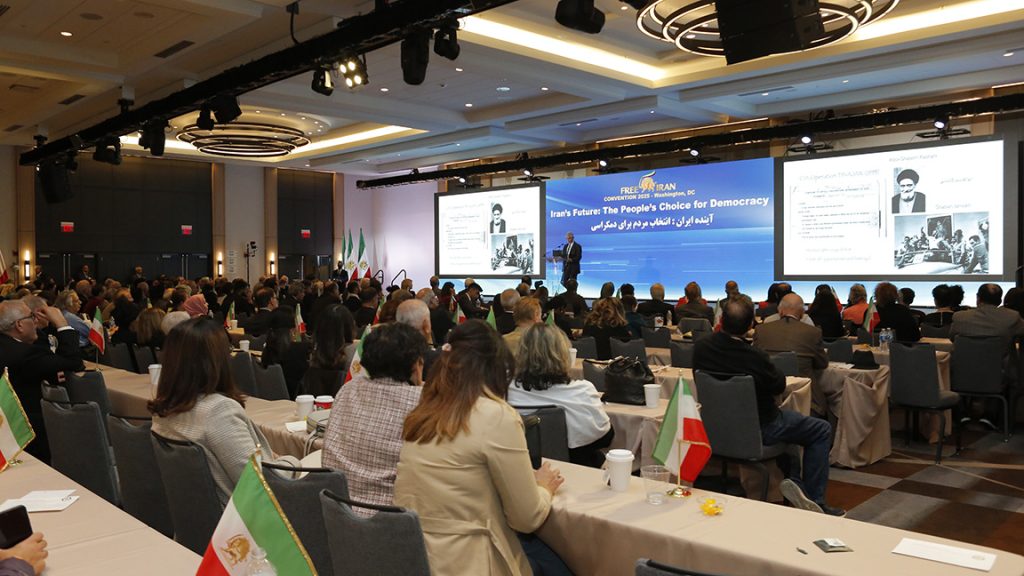
Washington, DC, November 15, 2025. The Free Iran Convention 2025 continued with a historical address from Professor Hossein Sadeghpour, a distinguished Harvard scholar. Professor Sadeghpour presented a documentary analysis of Iran’s 120-year-long struggle for democracy, characterizing it as an “epic struggle against the icons of authoritarianism and brutality.” His speech explored the recurring theme of opportunism and betrayal that has repeatedly hijacked the popular will—from the 1905 Constitutional Revolution and the 1953 coup against Mossadegh—to the theft of the 1979 revolution. Professor Sadeghpour concluded by asserting that the riddle of Iran can only be unlocked through internal resistance, led by the only force that has internalized these historical lessons: the organized opposition. Below is the full text of his remarks.
Mark Twain, the great American writer, once said, “There are many dates in a human’s life which are important. The day they are born, the day their children are born, the day they get married, the day their children get married, the day they graduate from college, the day their children graduate from college.” But there are only two days which are important in a human life. The day they are born and the day they found out why they are born.
The struggle to free Iran is the struggle to free Iran from the yokes of the Shahs and the Sheikhs. But it’s not on the screen. Oh, what is this? This is what happens when you use the Microsoft garbage. To free Iran from the yokes of the Shahs and the Sheikhs has been an epic struggle against the icons of authoritarianism and brutality. It has been a struggle to build institutions of democracy and the establishment of a plural and constitutional order.
You may have heard it has been a century-long struggle, and that this narrative, which I’m going to describe today, will document that has been a story of bravery, unrelenting spirit of free will, and also diametrically opposed a cautionary tale of opportunism and betrayal. At the end, what will unlock the riddle of Iran are lessons which are learned and are learned by whom? The story begins here with Sattar Khan and Baghar Khan, who were technically the constitutional framers, framers of the constitution of Iran in 1905.
It was the first enlightenment revolution in the Islamic world, the very first one. It led to the creation of the first popularly elected parliament, Majlis, in the Middle East, only to see an opportunist, an ahund, with aid from Russian troops, stormed the Majlis, killed the movement, and butchery and enslavement followed. Many of you in the audience, especially the older kind, will know who Nouri was. It took another two generations.
There was another first. Mohammad Mossadegh became the first democratically elected prime minister in the Muslim Middle East. He passed laws. He wanted to establish, of course, a government for the people and control its national resources for the people. The laws were going to make the world’s first oil company, international oil company, the Iranian, Anglo-Iranian oil company, which is now called, how many of you know this? BP.
BP, yes. British Petroleum, to be owned by the people and for the people. While it is now documented history that CIA with Operation Ajax in 1953 acted to remove Mosaddegh from power, it was operationally only possible by betrayal of yet another akhund, a mullah, Abul Ghasemi Kashani, and with the aid of his shock troops, the so-called Fedayan Islam, and of course, by paid mobsters and mercenaries such as Shahban Bimokh, which ended in the 28th Mordad, Mordad is the Iranian year, month, coup d’état.
Again, yet another tale of opportunism and betrayal. For those who are maybe interested in this internet dump of the CIA memo, it reads like this: Target, Prime Minister Mossadegh and his government. Objectives, through legal or quasi-legal methods to affect the fall of the Mossadegh government and to replace it with the pro-Western government under the Shah’s leadership. The CIA action, plan of action, was implemented in four phases.
This is how history evolves. Ajax became the first successful operation by CIA. It led to the downfall of Mossadegh, his arrest, and who eventually was brought to court in November 1953, and the Shah was brought back to power, and the CIA and MI6 had their man. And Iran officially became a client estate. Absolute rule pursued. It began in August of—immediately, in August of 1953, and went on for a couple of decades.
Those who paid were the Iranians. Among them were the entire Central Committee members of the Mojahedin Khalq Organization of Iran, who were killed in 1972. The man with the star, you can see, is AsgharBadi Zadeghan, who was at the time on the faculty of chemistry at the Technical University of Tehran. And here, as I have, has been also alluded by several speakers before me, for those people who still harbor some romantic illusions of monarchy in Iran, this should be a vivid reminder.
And then, of course, came later the killing of—these are just examples, OK? Every one of you perhaps could have equally well produced other examples. The killing of Mojahedin and Fidayyan members in April 1975, exactly 50 years ago. This particular one was orchestrated in a plot by a top SAVAK official whose name was Parviz Sabeti. I will come back to him soon. But people’s resolve endured.
It took a while, but it culminated in 1979 in the revolution against the Shah. Monarchy fell. You can see it says “Shah raft,” means Shah left, left Iran that is, for the second time, not for the first, but for the second time. But before he left, he did one thing on this stage. He demonstrated and proved to the people of Iran that he was forever the enemy of Iranian people. Forever.
The struggle succeeds, but the will of the people is again, I will come back to it and why this happens. For a third time, it was hijacked by the genocide of mullahs. Volumes have been written about this and said, but not everything, of course. Here you would naturally ask, why does this happen? How does history act in this really cruel and weird fashion? In his book, The 18th Brumaire of Louis Bonaparte, Karl Marx famously observed that history repeats itself the first time as tragedy, the second time as farce.
This profound statement, which is of course now in textbooks, as a meditation on the French Revolutions of 1789 and 1848, first, the overthrow of the monarchy, then the rise of Louis-Napoleon Bonaparte, was not only a comment on political recurrence, it was a philosophical appeal to the physical principle of causality. It’s a bedrock of physics, the idea that every effect springs from a cause, and that history is governed by chain reactions of error and betrayal.
Viewed from this lens, Iran’s modern history is painfully instructive. The 1979 revolution, ultimately captured by theocratic despotism, began as a genuine struggle, an uprising, a collective cry against the monarchy that has turned into a modern tyranny. The Pahlavi regime, with its savakh apparatus, trained in the dark art of surveillance and torture, sowed its own demise, its own collapse, without this brutality and arrogance of Mohammad Reza Pahlavi’s rule created the very vacuum into which Khomeini and his clerical cohort surged, unleashing a reign of terror that endures to this day.
Massoud Rajavi, pictured here, was only released from religion, from prison a few weeks before their revolution succeeded. This, ladies and gentlemen, is the cause and effect Marx has alluded to. Now Iran stands again on the precipices of change. When an evolutionary path forward from history, it actually exists. We have been discussing it since this morning. But as the saying goes, when the stars come out, so do the bats.
This time, history not merely repeats itself, it spews the past. What it brings up is not a coherent narrative but a toxic mixture of revisionism, opportunism, and betrayal, an amalgam of historical artifacts woven into the fabric of lies and deceit. A clique of grotesque wannabes, those regurgitated, monarchist, and long-dormant former torturers of Iran’s youth, skilled in the art of deception and treasury, they are at it. They are the noxious mix of chemicals when history throws up.
Men who have not held an honest day’s job. Not even an honorable graveyard shift at a 7-Eleven. One claims that he could not have been a torturer because he was trained in law. This is not only hollow, it is grotesque. History offers parallels, grim parallels. Hans Frank was a German lawyer before he became the Nazi governor of occupied Poland. He was hanged in Nuremberg for his crimes against humanity.
Legal training is no inoculation against moral depravity. But finally, the long arm of the law at last may now have been wrapped around his neck. These unrepented charlatans of yesteryears now find, now make actually bets, bets with the Revolutionary Guards. They harbored dreams of coronating the killers of Iran’s youth. This, ladies and gentlemen, is the monarchist Machiavellian dream. This is their proto-model for ruling Iran.
This is how they want to gain power. The question is, why? Why we may be here? It may be for the lessons that you and I refuse to learn over and over again. It is when we ignore these lessons is when and how we surrender ourselves to the vicious cycle of brutality and betrayal. What are those lessons? First, Iranians of all masses thoroughly rejected monarchy in their ranks in 1979, period.
As a number two, that they paid in blood of Iran’s youth, forged in the crucible of torture, rape, and execution. But foremost of all, freedom is never bestowed by dynasties on foreign patrons. It is earned through sacrifice, resistance, and unbreakable commitment to justice. These are not merely wars for a class on politics, but these are things which are now being practiced.
Has anybody learned these lessons? Is there really hope? Of course, in this convention, in this gathering, these are merely rhetorical postures. Why? Because it is here that history now acts as a distiller. Just as any parent knows that when a child throws up is the human body’s attempt to rid itself of toxins, the current historicalist view is a manifestation of Iran body politics ridding itself of the remains of diseased organs.
This distillation is absolutely necessary to accelerate the progress toward the establishment of a free Iran. Now, the ultimate question is, as I also said at the beginning, whom does it? There is only one group right now, as we speak, which has crystallized all of these above lessons into action, into practice. It has a historically accurate roadmap for a democratic future in Iran.
It has an evidence-based approach to resistance. And also importantly, it has a government which works in exile. Before I turn by my concluding slide, I’d like to sort of share a thought, one which sort of derives from my professional strength. Newton’s third law is the bedrock of classical physics. All of those people who have taken physics in undergraduate, in college, I am sure must have seen it.
In fact, you act it every time you get up from the bed, from your chair. It is the Newton’s third law that pushes you up. For every action, there is a reaction. Every reaction is a response to an action. We interrogate the world. This I do in my job. The universe, by the responses we receive from the interactions in the physical realm.
To understand what Mojahedin are, what NCRI does, you barely listen to what the words the regime utters and how it reacts. Now, the new Iran will not have a need for an icon of authority, culture, or religion. Iran’s liberation will not be paved with the ill-gotten gold of People’s Treasury, and it will be written in the blood and tears of those who shout, “We shall free Iran.”