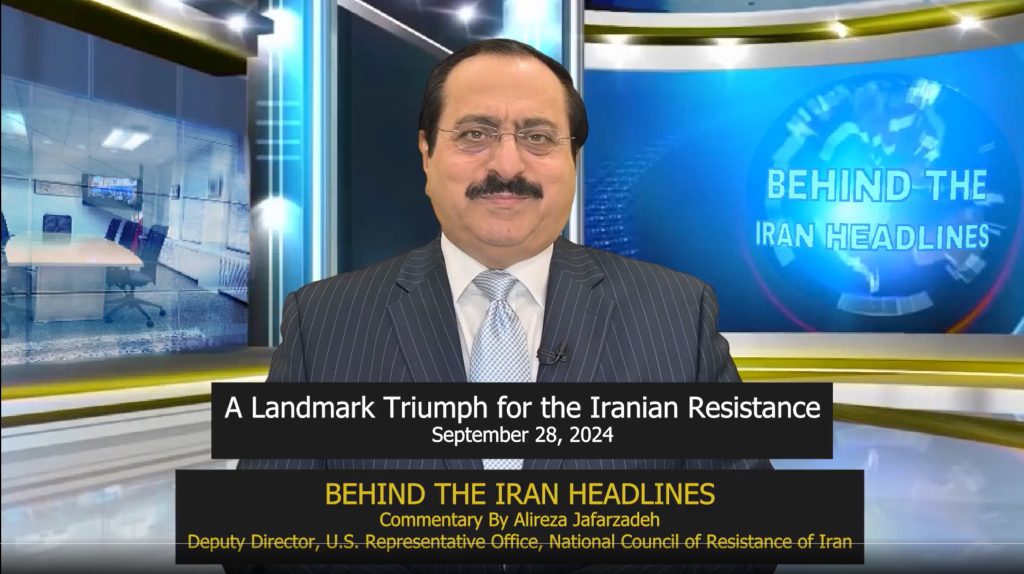
BEHIND THE IRAN HEADLINES Series, September 28, 2024, Alireza Jafarzadeh, NCRI-US Deputy Director
Twelve years ago today, on September 28, 2012, the U.S. State Department revoked the designation of the main Iranian opposition movement, the Mujahedin-e Khalq (MEK) as a Foreign Terrorist Organization. This momentous decision, prompted by a unanimous June 1, 2012 ruling by the U.S. Court of Appeals for the District of Columbia, also included the National Council of Resistance of Iran. It marked the culmination of a 15-year legal and political battle, a historic victory for the Iranian Resistance.
The court, finding no evidence of terrorism, gave Secretary Clinton a four-month deadline to revoke the designation. This verdict underscored the politically motivated nature of the 1997 blacklisting, which a senior U.S. administration official at the time admitted to the Los Angeles Times was “intended as a goodwill gesture to Tehran and its newly elected moderate President Mohammad Khatami.”
In contrast, a bipartisan House Majority initiative in 1998 rejected the designation, recognizing the MEK as “a legitimate resistance movement,” warning that such a “wrong-headed policy” would only embolden the regime.
The MEK’s delisting was the culmination of a series of landmark legal victories where the rule of law triumphed over political expediency:
- In November 2007, the United Kingdom’s Proscribed Organizations Appeal Commission rejected the MEK’s proscription, leading to its official de-proscription by the UK government in June 2008.
- In December 2008, the Court of First Instance of the EU forced the European Union to remove the MEK from its list of banned terror organizations in January 2009.
- In May 2011, the Investigative Magistrate of Paris’ antiterrorism department dropped all terrorism charges against the MEK, acknowledging its activities as legitimate resistance.
The 2012 revocation was a testament to the MEK and the broader Iranian Resistance’s resilience and unwavering commitment to a democratic, secular, and non-nuclear republic Iran.
The MEK’s blacklisting was a stark manifestation of the West’s misguided policy of appeasement toward the Iranian regime. This policy’s inertia persists to this day, hindering the Iranian people’s struggle for freedom and democracy while jeopardizing regional peace and stability.
It is a policy that demands urgent reversal.