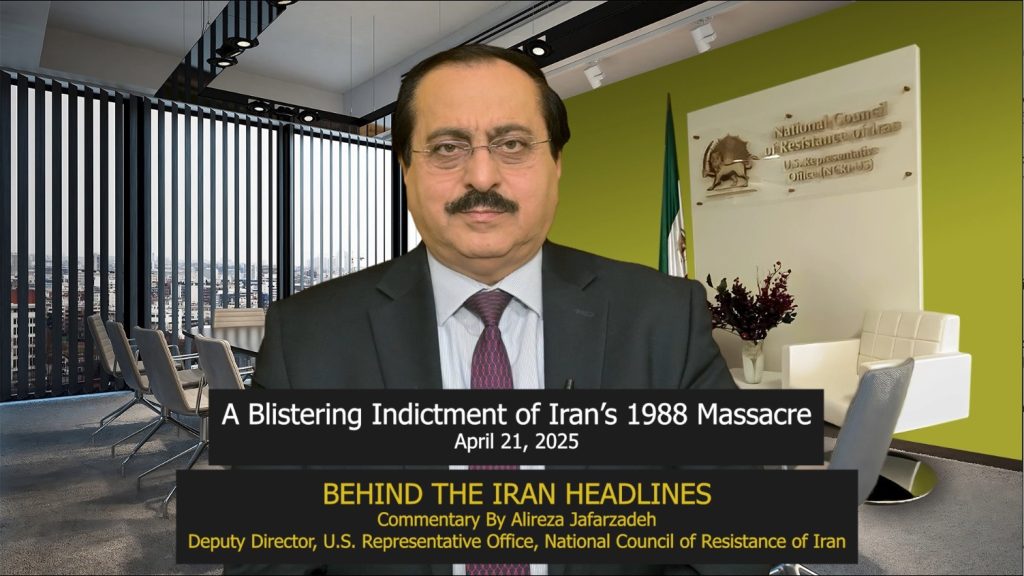
BEHIND THE IRAN HEADLINES Series, April 21, 2025, Alireza Jafarzadeh, NCRI-US Deputy Director
In 1988, the Iranian regime carried out one of the most heinous crimes of the 20th century—a massacre of over 30,000 political prisoners, the majority of them supporters of the main opposition Mojahedin-e Khalq, or the MEK.
This mass execution was not the result of war or chaos. It was a premeditated purge, ordered by the regime’s founder Khomeini himself, and carried out with chilling precision by what came to be known as the “Death Committees.”
Now, a newly released audio recording from Ayatollah Montazeri—then heir apparent to Khomeini—sheds even more damning light on this genocide. Speaking to members of the Death Committee, Montazeri reveals that 10,000 MEK supporters were marked for execution simply for reading leaflets or newspapers. This was mass extermination based on thought, faith, and affiliation.
In August 2016, an audio file of Montazeri’s first meeting with the Death Committee on August 15, 1988, was released, exposing horrifying details of what he called “the greatest crime in the history of this regime.”
Montazeri recounts horrifying details in the second meeting. He confirms that three hundred female members of the MEK, including two French nationals, were summarily executed.
Perhaps most striking is Montazeri’s admission that the clerical ruling system, known as Velayat-e Faqih has become “disgusting” to the people. Even families of the executed began to question the regime’s legitimacy and say, “The MEK were right all along.”
Montazeri’s words confirm what the Iranian Resistance has long asserted: the 1988 massacre was a crime against humanity and a genocide, as recognized by the UN Special Rapporteur on Iran, Professor Javaid Rehman, last year.
The architects of the 1988 massacre are in power today. And so long as impunity reigns, the regime’s brutality will continue. Accountability is not just a moral imperative. It is a necessary step toward justice and freedom for the Iranian people.