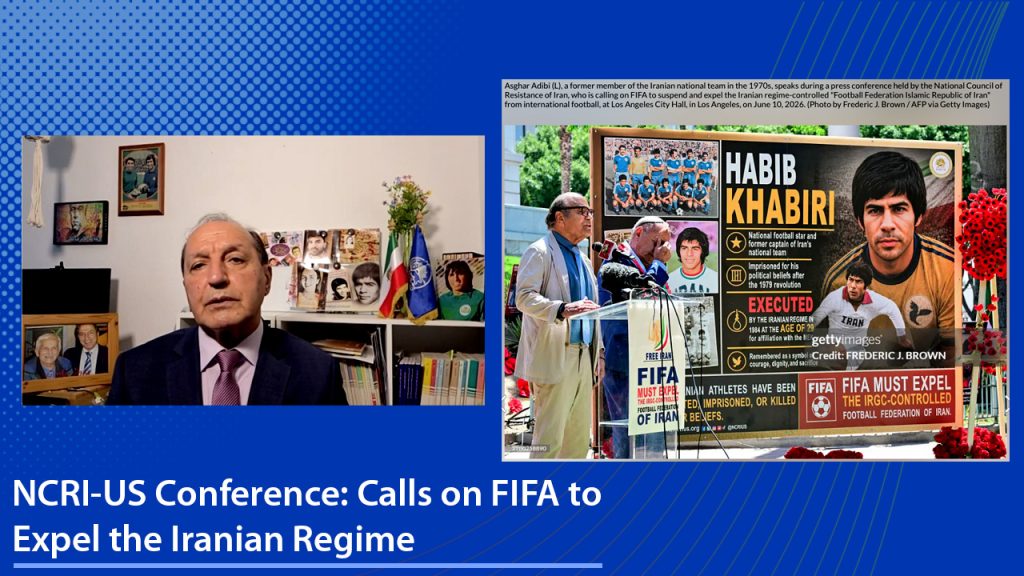
NCRI-US Conference and Exhibition Calls on FIFA to Expel the Iranian Regime Due to IRGC Control and Human Rights Violations
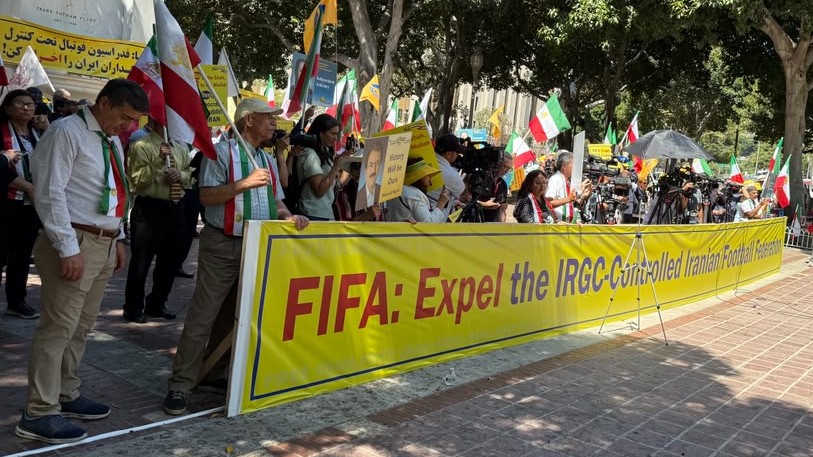
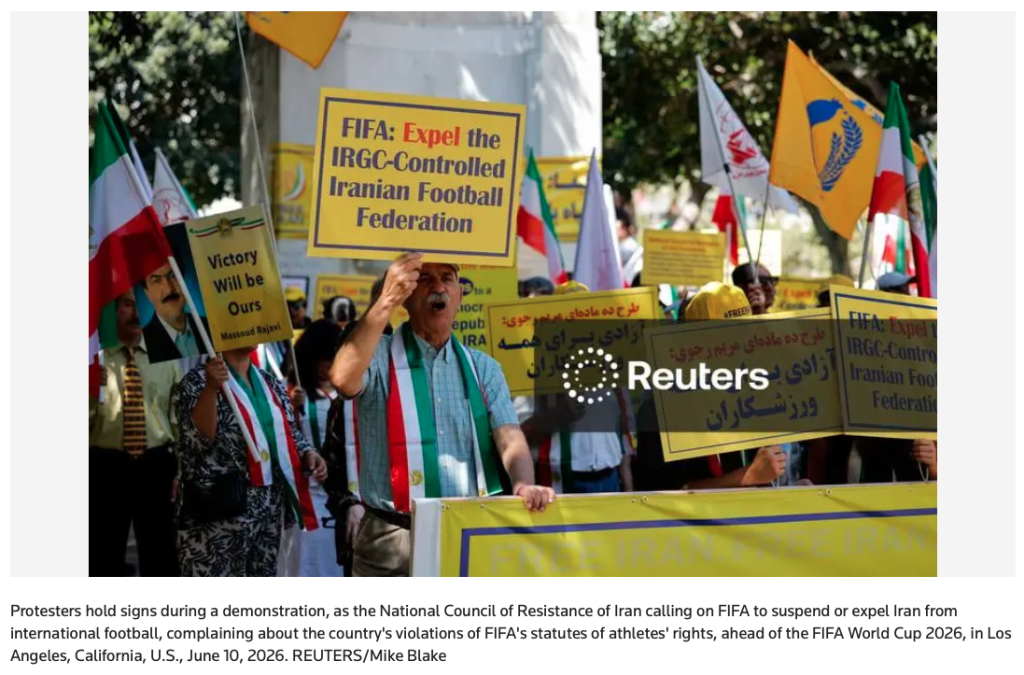
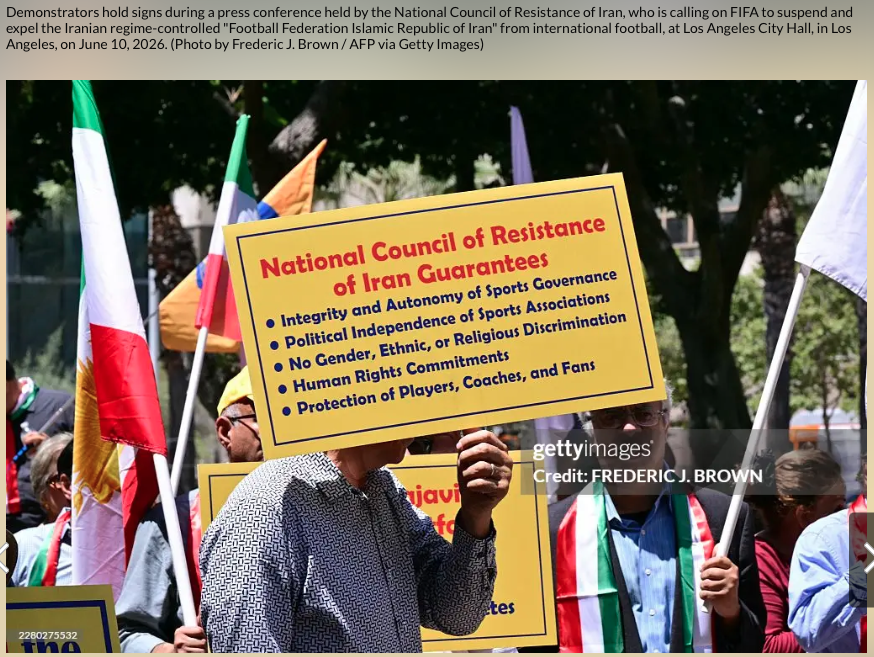
LOS ANGELES, Calif. – June 10, 2026 — As the world’s attention turns to the opening days of the 2026 FIFA World Cup, the U.S. Representative Office of the National Council of Resistance of Iran (NCRI-US) held a press conference and exhibition on the South Lawn of Los Angeles City Hall, calling on FIFA to expel the Iranian regime for systematic political interference by the Islamic Revolutionary Guard Corps (IRGC), widespread repression of athletes, and persistent violations of FIFA’s own statutes.
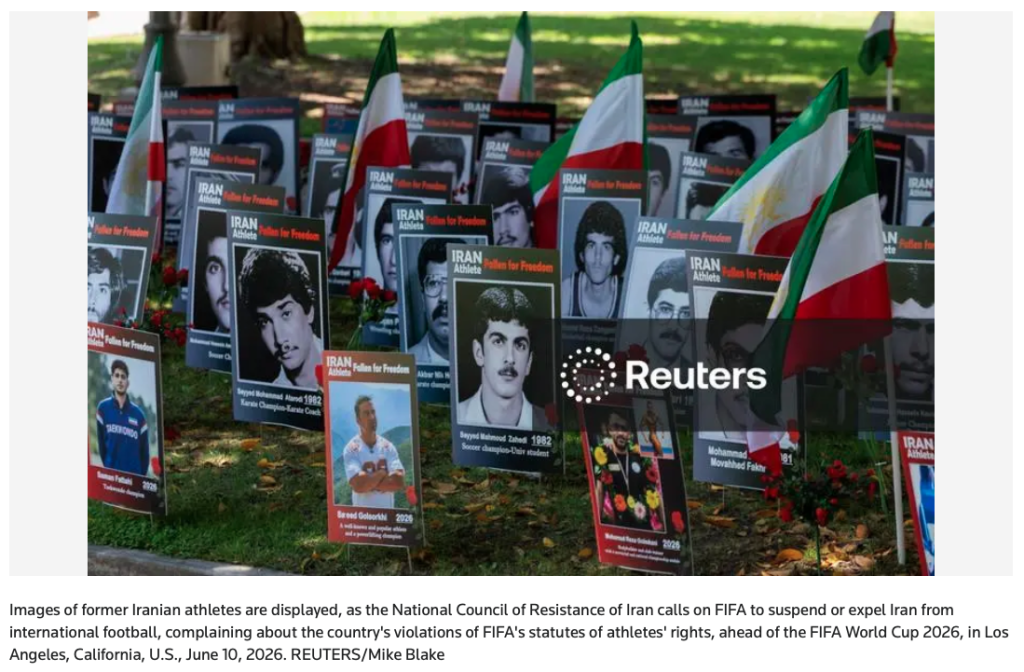
The event brought together former Iranian national team players, championship athletes, youth representatives, and members of the Iranian-American community. It featured hundreds of photographs and displays honoring Iranian athletes who were persecuted, imprisoned, and executed for supporting democratic change in Iran. Participants honored the athletes who had fallen for freedom by laying flowers and holding their pictures during a march.
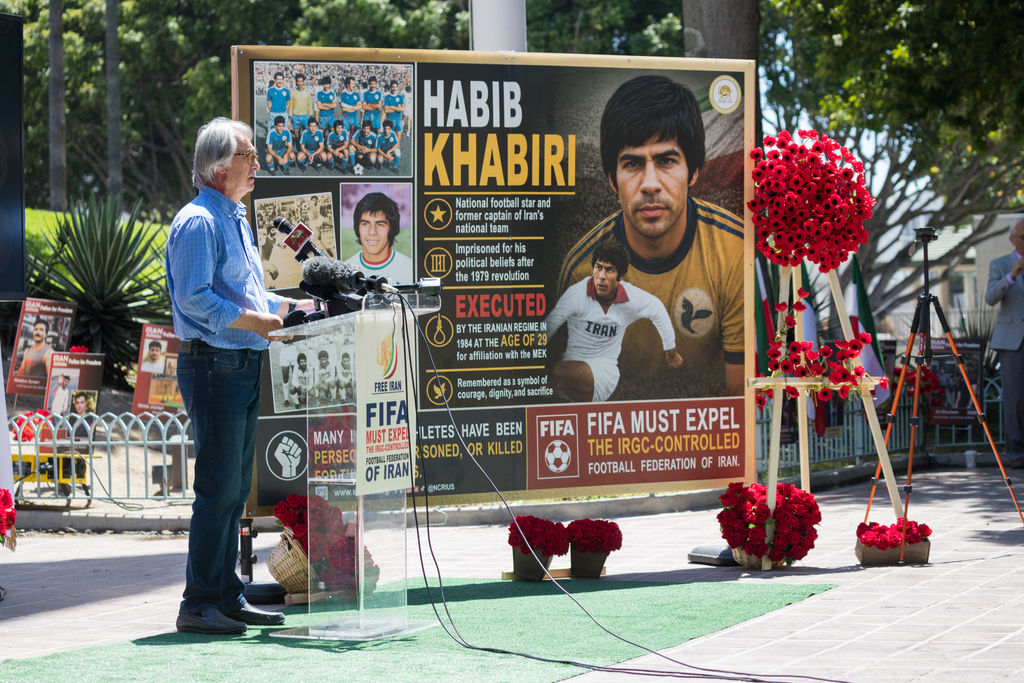
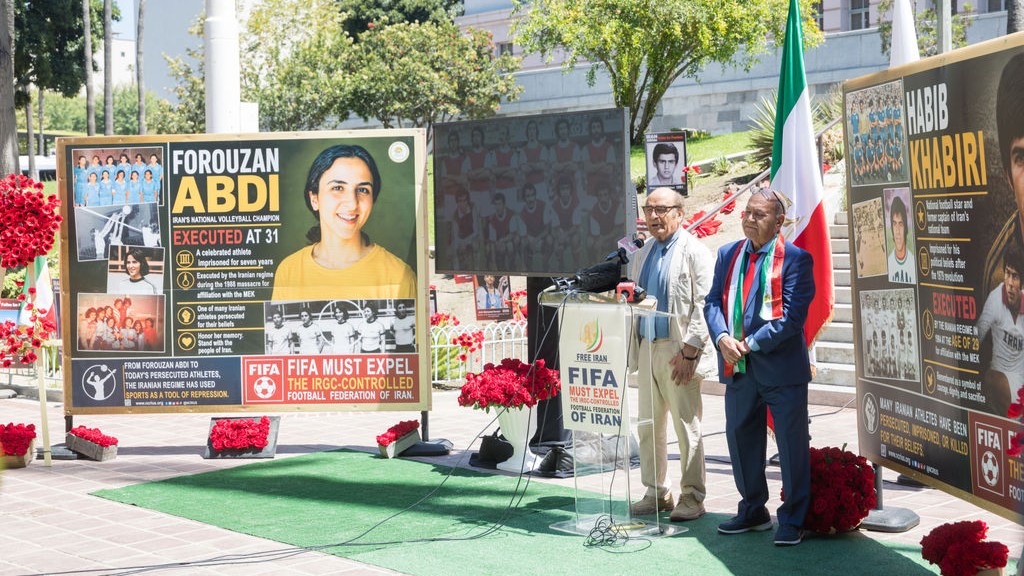
The conference emphasized that sports in Iran have become instruments of political control rather than institutions independent of government influence.
The event coincided with growing international scrutiny of the Iranian Football Federation and followed reports highlighting that the Iranian regime has reportedly used football clubs and sporting institutions as tools of surveillance and political repression.
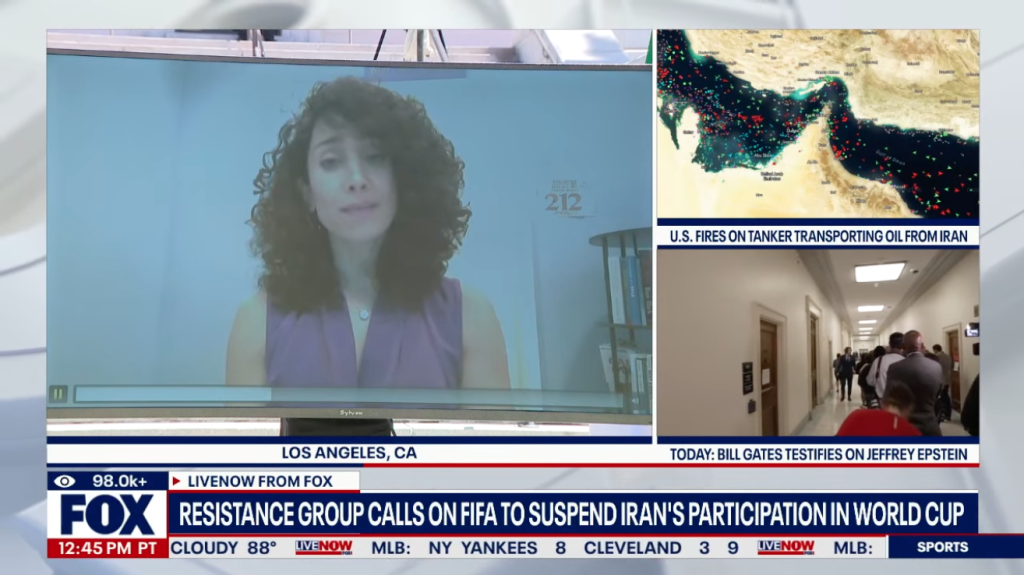
In a Fox News report published earlier in the day, NCRI-US Deputy Director Alireza Jafarzadeh cited evidence that Iran’s football infrastructure has been utilized by the regime and the IRGC, a designated terrorist entity, to monitor citizens and athletes, arguing that such practices violate FIFA’s requirements for independence from political and military interference.

NCRI names at least 15 people it describes as IRGC or security-linked figures who have held senior positions in clubs, federations, league management, or sports bodies. Among them, NCRI-US identifies Mehdi Taj as a former IRGC intelligence officer who currently heads the Iranian soccer federation.
• Iran allegedly used soccer clubs to spy on citizens, opposition group urges FIFA ban regime before World Cup (Fox News Interview with Alireza Jafarzadeh)
FIFA Statutes and Political Interference
Opening the conference, Hamid Azimi, a member of the NCRI, stated that the Iranian Football Federation operates under the direct influence of the IRGC, a situation he argued constitutes a clear violation of FIFA regulations requiring football associations to remain independent of political and governmental control. “FIFA’s statutes require member associations to manage their affairs independently, free from third-party influence,” Azimi said. “Yet the Iranian Football Federation operates under the shadow of the IRGC.”
According to Azimi, the penetration of the IRGC into Iranian football is not merely indirect influence but a deliberate effort to dominate sporting institutions. He pointed to the leadership of the federation and the presence of former IRGC officials in key positions throughout the football system.
He further argued that athletes who express support for democratic protests face intimidation, arrest, imprisonment, professional bans, and public targeting by state-controlled media.
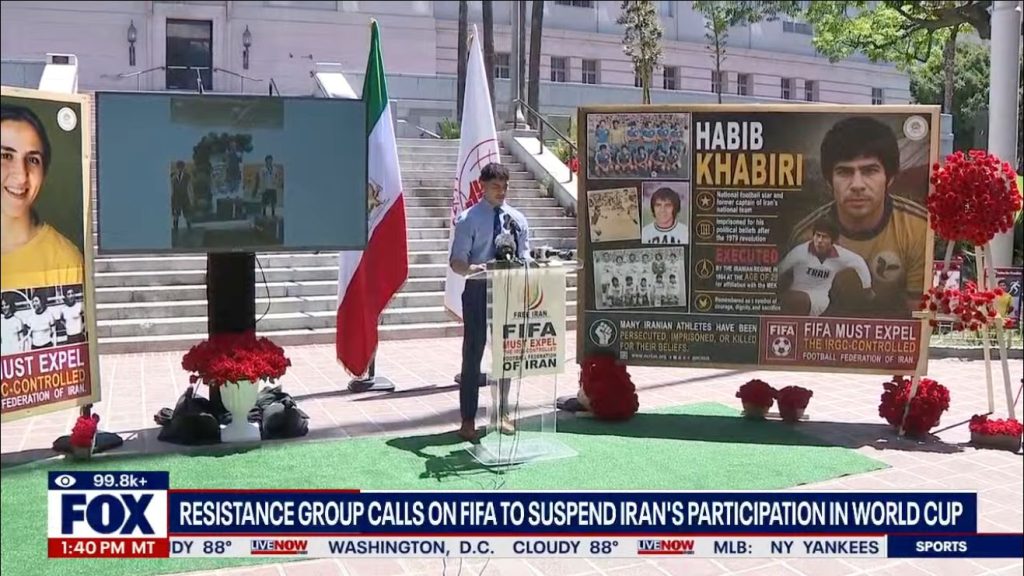
Azimi highlighted the cases of numerous athletes executed over the past four decades, including former national football captain Habib Khabiri, national volleyball player Forouzan Abdi, and Olympic wrestler Houshang Montazer-ol-Zohour, all of whom were killed for their political beliefs and support for the Iranian opposition, the MEK.
Drawing a parallel with international action taken against apartheid-era South Africa, Azimi urged FIFA to take similar action regarding Iran’s football federation. “The same regime that controls football clubs executes athletes, suppresses women, and denies freedom to an entire nation,” he said.
Asghar Adibi: Athletes Should Inspire, Not Fear
Former Iranian national team footballer Asghar Adibi described the regime’s treatment of athletes as one of the clearest examples of its broader repression of society. As the world focuses on the World Cup, we must not forget the hundreds of athletes who have been killed by the Iranian regime, he said.
Adibi argued that football in Iran has effectively been placed under IRGC control and emphasized that such interference started early as the regime soon found itself opposing the people. Because people soon engaged in a struggle for freedom, the athletes sided with the people and opposition groups, particularly the People’s Mojahedin Organization of Iran (PMOI/MEK).
The first opposition to the ruling clerics in Iran was formed in Tehran’s Amjadieh stadium shortly after the regime came to power. And that desire for change continues to this day.
“Habib Khabiri is the hero of Iranian sports because he sacrificed his life for Iran’s freedom,” Adibi said. Many athletes had a similar goal: those who underwent torture and years of imprisonment, but maintained their commitment to the people of Iran.
Adibi also pointed to the nationwide protests that spread across all 31 provinces of Iran in January 2026, saying they demonstrated the Iranian people’s desire for democratic governance and an end to clerical rule.
Reflecting on a recent statement by the Sports Committee of the NCRI, he urged FIFA to apply the same standards used against apartheid in South Africa and expel Iran’s regime from international competition.
The former football star said his greatest pride today is standing with the Iranian people, being a member of the NCRI, and supporting its efforts to establish a democratic republic. He said that the NCRI is committed to the Ten-Point Platform introduced by Mrs. Maryam Rajavi, who is the president-elect of the NCRI.
Adibi highlighted the NCRI’s sports platform, which advocates equal opportunity, non-discrimination, athlete protections, and the complete separation of sports from political control.
Adibi invited all athletes to join the massive rally on 20 June 2026, in Paris. The goal is to free Iran, which would, among other things, stop the execution of the youth in Iran.
Bahram Mavaddat: From the First World Cup to the Fight for Freedom
Former Iranian national team goalkeeper Bahram Mavaddat, a member of Iran’s historic 1978 World Cup squad, reflected on his decades-long involvement in Iranian football and the transformation of sports institutions after the 1979 revolution.
Mavaddat recalled the optimism many athletes felt following the fall of the monarchy, hoping that sports organizations would finally be managed by qualified professionals rather than military or intelligence figures. Instead, he said, the opposite occurred. “Members of the Revolutionary Guard infiltrated all the organizations and bodies of Iranian sports, including the Football Federation,” he said.
Mavaddat argued that Iranian athletes increasingly felt compelled to stand alongside their fellow citizens during protests and uprisings. As a result, many faced arrest, torture, imprisonment, and execution.
He cited the executions of Habib Khabiri and Forouzan Abdi as examples of the regime’s longstanding hostility toward athletes who support freedom and democracy.
The former national goalkeeper also referenced the execution of wrestler Navid Afkari, whose death drew worldwide condemnation, and noted that athletes have continued to be targeted during and after the nationwide protests that erupted in January 2026.
Mavaddat contrasted Iran’s current sports system with the NCRI’s vision for a future democratic republic, emphasizing the importance of having qualified, honest professionals in sports leadership positions rather than political appointees.
He concluded by calling attention to a major demonstration scheduled for June 20 in Paris, where tens of thousands of Iranians and supporters of democratic change are expected to gather.
“We want our voices, together with those of the demonstrators, to be the voice of the people of Iran and the voice of the athletes,” he said.
Dr. Soolmaz Abooali: Human Rights Must Remain Central
Three-time world champion and sixteen-time U.S. national traditional karate champion Dr. Soolmaz Abooali spoke from the perspective of an athlete who grew up enjoying freedoms unavailable to many of her counterparts inside Iran.
“I carry those freedoms with me,” she said, “and I speak today for Iranian athletes who deserve the same rights, dignity, and freedom to live and compete without fear,” Abooali stressed that athletes are first and foremost human beings whose rights must never be overshadowed by the spectacle of sport.
She honored a series of athletes who lost their lives after standing against oppression, including Houshang Montazer-ol-Zohour, Habib Khabiri, Forouzan Abdi, Navid Afkari, Mohammad Mehdi Karami, Saleh Mohammadi, and Sasan Azadvar.
“These were not symbols,” she said. “They were athletes. They trained, competed, inspired others, and dreamed of a future.” Abooali argued that freedom and sport are inseparable because both require courage, discipline, and sacrifice.
She urged international organizations, including FIFA, to ensure that human rights remain central to decisions concerning participation in global sporting events.
The karate champion also highlighted the NCRI’s vision for the future, citing principles of gender equality, ethnic and religious equality, protection of athletes and fans, and institutional commitments to human rights. “Without athletes, there is no sport,” she said. “And without freedom there is no true competition.”
Youth Perspective: Milad Sharif
One of the most moving presentations came from Milad Sharif, a sixteen-year-old wrestler born in the United States to Iranian parents.
Sharif explained that although he has never lived in Iran, the struggle for human rights there has shaped his entire life. “As a wrestler, this issue is deeply personal to me,” he said. He spoke about his admiration for legendary Iranian wrestler Gholamreza Takhti, whom he described as a symbol of honor, humanity, and service to the people.
Sharif then focused on the story of Saleh Mohammadi, a young wrestler reportedly executed shortly after his nineteenth birthday. “Someone my age,” Sharif said. “Someone who should have been training, competing, dreaming about the future.”
He described the execution as a reminder of the price many athletes pay for supporting freedom and democracy.
Despite the tragedies, Sharif expressed optimism about Iran’s future and praised Maryam Rajavi’s Ten-Point Plan as a roadmap toward a country without executions, discrimination, or repression. “As a young athlete, I dream of a day when I can compete freely with Iranian athletes—not as victims of a regime, but as equals, as friends, as champions,” he said.
Remembering Habib Khabiri
Yousef Mahdavi who, for years, played with Habib Khabiri on the football club, Homa, recalled his kind and humble manner. Mahdavi said that Khabiri was very decisive in drawing a clear line with the regime early on after the revolution.
Shahram Homayounfar offered a deeply personal account of his friendship with former national team captain Habib Khabiri. Having played alongside Khabiri during the 1970s, Homayounfar described him as both an extraordinary footballer and an exceptional human being. “He was warm, humble, and genuinely kind,” he said.
According to Homayounfar, Khabiri’s popularity, integrity, and commitment to freedom made him a target of the regime. Khabiri was arrested, tortured, and ultimately executed on June 21, 1984.
“The regime wanted him to denounce the organization that he was affiliated with, the MEK, and he refused to bow to the Iranian regime and fulfill their wishes,” Homayounfar said. “He chose freedom and dignity.”
A Unified Message
Throughout the conference, speakers returned to a common theme: sports should unite people, inspire excellence, and protect human dignity—not serve as instruments of repression and political control.
The event concluded with a renewed appeal for solidarity with Iranian athletes and support for a democratic, secular, non-nuclear republic based on freedom, equality, and respect for human rights.