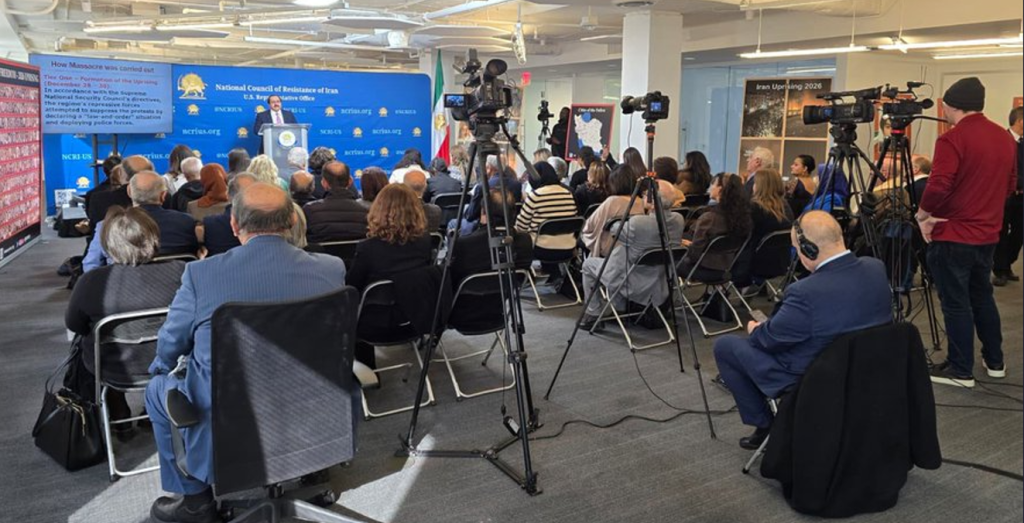
Washington, DC, February 6, 2026. The National Council of Resistance of Iran – U.S. Representative Office (NCRI-US) has released new findings detailing the Iranian regime’s premeditated orders behind the January 2026 massacre and the central role of the IRGC in the violent suppression of the nationwide uprising. The report draws on evidence and analysis presented during a February 3, 2026, press conference in Washington, D.C., featuring senior NCRI officials Soona Samsami, the NCRI Representative in the United States, and Alireza Jafarzadeh, the Deputy Representative.
Executive summary
The January 2026 uprising marked one of the most significant nationwide challenges to the Iranian regime in decades. Triggered by economic collapse but rapidly evolving into a political revolt, the protests spread to more than 400 cities. NCRI-US officials presented evidence that the regime’s response—including mass killings, widespread arrests, and the deployment of IRGC units—was not reactive but the result of pre-planned directives issued at the highest levels.
The report concludes that:
- The massacre was premeditated, coordinated through top-secret meetings.
- The IRGC executed a systematic, nationwide suppression plan.
- The regime’s actions constitute crimes against humanity.
- The uprising reflects a deep, irreversible rupture between the Iranian people and the ruling establishment.
- The Iranian people’s right to resist is grounded in international human rights principles.
- The international community must adopt a firm, principled policy supporting the Iranian people’s democratic aspirations.
The complete PDF version of this report, including photos and documentation, is available here.
Background
The uprising began on December 28, 2025, amid soaring inflation, currency collapse, and widespread unemployment. What started as protests over economic hardship quickly transformed into a political movement demanding an end to dictatorship.
Key contextual factors:
- Nationwide participation: merchants, students, teachers, retirees, women, and youth.
- Geographic spread: protests erupted in major cities (Tehran, Mashhad, Isfahan, Shiraz) and smaller towns historically less politically active.
- Regime vulnerability: internal documents revealed concerns about “loss of control” and “unpredictable escalation.”
The regime responded with:
- Martial law in several provinces.
- Complete internet shutdowns to block communication.
- Deployment of IRGC special units, including Saberin and Imam Ali brigades.
- Live ammunition, armored vehicles, and rooftop snipers.
Key findings from the NCRI-US briefing
1. Premeditated regime orders
NCRI-US revealed that the massacre followed explicit instructions issued during a top-secret meeting involving senior officials from the Supreme Leader’s office, the IRGC, the Ministry of Intelligence (MOIS), and the national security apparatus.
Evidence presented included:
- Directives authorizing the use of lethal force from the outset.
- Orders to seal hospitals, preventing treatment of wounded protesters.
- Instructions to identify and arrest organizers, particularly MEK supporters.
- Coordination between provincial governors and IRGC commanders to implement a unified suppression plan.
These findings contradict the regime’s public narrative that the violence was “spontaneous” or “provoked by rioters.”
2. Central role of the IRGC
The IRGC was the primary operational force behind the crackdown.
NCRI-US detailed:
- Deployment of IRGC units to at least 22 provinces.
- Use of snipers, armored personnel carriers, and helicopter surveillance.
- Targeting of medical facilities, including the arrest of doctors treating wounded protesters.
- Systematic tracking of injured demonstrators through hospital records.
- Coercion of families to pay for the bullets used to kill their loved ones.
The IRGC’s actions were not isolated incidents but part of a coordinated national strategy.
3. Scale of repression
The report highlighted the staggering human toll:
- Thousands killed, including children and teenagers.
- Tens of thousands injured, many denied medical care.
- Over 50,000 arrests, with detainees held in overcrowded, makeshift facilities.
- Torture and forced confessions, documented through eyewitness accounts.
Despite this, protests continued for weeks, demonstrating the population’s determination.
4. The right to resist
Both Samsami and Jafarzadeh emphasized that the Iranian people’s resistance is:
- Legitimate under international law.
- Necessary given the regime’s systematic use of lethal force.
- Rooted in decades of organized struggle, particularly through the MEK.
They argued that the right to resist is not an abstract principle but a practical necessity for survival under a regime that routinely kills peaceful protesters.
5. Implications for Iran’s future
The speakers stressed that the regime’s violent response reflects:
- Fear of collapse, not confidence.
- Loss of control over key segments of society.
- Growing influence of organized resistance networks.
The uprising revealed:
- A nationwide rejection of the regime.
- A unified demand for democratic change.
- A historic opportunity for transition.
Statements from NCRI-US officials
Soona Samsami, US Representative, National Council of Resistance of Iran
Samsami opened by offering condolences to families of children killed during the uprising, calling the deaths “a national wound that will not be forgotten.”
She emphasized:
- The uprising’s political nature, not merely economic frustration.
- The regime’s unprecedented brutality, including IRGC deployment in major cities.
- The resilience of protesters despite mass killings.
- The NCRI’s roadmap for democratic transition, including:
- A provisional government.
- Free elections within six months.
- Separation of religion and state.
- Gender equality and abolition of the death penalty.
Ms. Samsami quoted Mrs. Maryam Rajavi: “The question is not if the regime will fall, but when, and what will replace it to avoid chaos.”
Alireza Jafarzadeh, Deputy US Representative, National Council of Resistance of Iran
Jafarzadeh presented intelligence showing:
- The regime’s internal panic, revealed in confidential meetings.
- Recognition among officials that the uprising represented a strategic defeat.
- Evidence that the massacre was planned in advance, not a reaction.
He stated that the regime’s actions meet the criteria for crimes against humanity, citing:
- Use of live ammunition against unarmed civilians.
- Targeting of hospitals.
- Systematic torture and forced confessions.
- Execution of detainees without due process.
He concluded that the uprising demonstrated a nationwide desire for change, contradicting the regime’s claims of stability.
Call to the international community
NCRI-US urged governments worldwide to:
- Recognize the Iranian people’s right to resist.
- Condemn the regime’s crimes against humanity.
- Impose targeted sanctions on IRGC commanders.
- Support the Iranian people’s democratic aspirations.
- Reject the regime’s narrative and propaganda.
The report stressed that neutrality in the face of mass killings is morally indefensible.
Conclusion
The January 2026 massacre represents a turning point in Iran’s modern history. The NCRI-US report demonstrates that the regime’s violence was premeditated, coordinated, and executed with the intent to crush a nationwide demand for freedom. Yet the uprising revealed the depth of public rejection of the regime and the strength of organized resistance.
As the struggle continues, the international community faces a clear choice: stand with a regime that commits crimes against humanity, or stand with a people fighting for freedom, dignity, and democracy.
The NCRI-US calls for decisive global action to support the Iranian people and hold the regime accountable.
The complete PDF version of this report, including photos and documentation, is available here.