Hamid Enayat, Originally published by Real Clear World, August 11, 2026
Iran’s geography ensures that the consequences of its domestic politics cannot remain within its borders. The country overlooks the Strait of Hormuz, lies between the Persian Gulf and the Caspian Sea, and connects the Middle East with Central and South Asia. Prolonged instability in Iran can therefore threaten regional security, disrupt energy supplies and impose costs on the global economy.
Yet Western policy continues to treat the Iranian people’s demand for political change as separate from these strategic concerns. Human rights are discussed in one forum, nuclear proliferation in another and regional security in a third. In reality, they are different dimensions of the same crisis.
A government that cannot rely on the consent of its people must seek security through other means. In Iran, that has meant repression at home, confrontation abroad and the cultivation of proxy forces across the region. The regime’s domestic fragility does not encourage moderation; it creates an incentive to export insecurity beyond Iran’s borders.
This connection has become particularly visible during the latest war. While international attention has focused on military strikes, missile capabilities and the security of energy corridors, the Iranian authorities have intensified repression inside the country. The war has provided not only a national-security justification for silencing dissent but also a degree of international invisibility. Executions that might otherwise provoke widespread condemnation risk becoming footnotes amid reports of airstrikes and diplomatic negotiations.
Agence France-Presse recently documented the execution of Vahid Baniamerian, a physicist convicted of membership in the People’s Mojahedin Organization of Iran. His family reportedly learned of his execution only after state media announced it. Amnesty International has warned that dozens of people have been executed on politically motivated charges after grossly unfair trials since the war began. Around 100 political prisoners are reportedly under sentence of death, while rights groups say the authorities have carried out more than 400 executions since the beginning of the year.
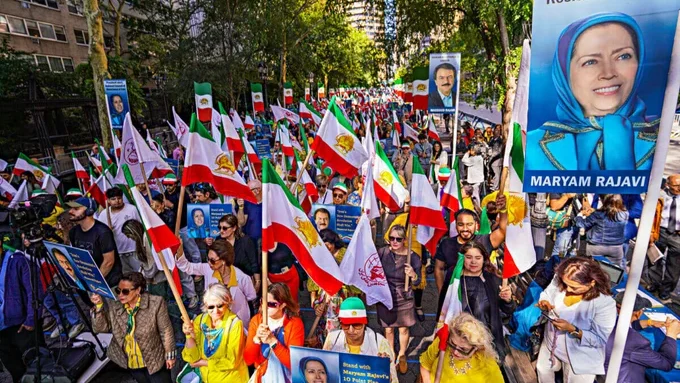
The scale of this crisis is now provoking resistance from within Iran’s prisons. According to the National Council of Resistance of Iran, 1,500 death-row prisoners in Ghezel Hesar prison entered the tenth day of a hunger strike and sit-in on July 21. Several reportedly sewed their lips shut, and some began refusing water. Their protest offers a stark illustration of the confrontation between a coercive state and citizens who are increasingly prepared to resist it, even under the threat of death.
These events are not merely a human-rights tragedy unrelated to geopolitics. They reveal a government whose security depends more on coercion than public consent. Permanent confrontation enables Tehran to portray domestic opponents as agents of foreign powers, justify censorship and executions in the name of national security, and unite the Revolutionary Guards, intelligence services, clerical institutions and proxy networks around a common external enemy.
For Iran’s new and still untested leadership, external conflict can also serve as a substitute for legitimacy. It can demand unity from the Revolutionary Guards, intelligence services and rival factions before establishing genuine authority over them. War thus becomes not merely a foreign-policy choice but an instrument of internal consolidation.
This helps explain why agreements that reduce regional tensions may prove fragile if they leave the structure of power inside Iran untouched. A government dependent on confrontation cannot easily abandon it without undermining one of its central mechanisms of control. Even when Tehran signs a ceasefire or memorandum of understanding, the incentives that produced its destabilizing conduct remain in place.
The danger is magnified by Iran’s control over territory bordering the Strait of Hormuz. Roughly one-fifth of global petroleum consumption and a significant share of internationally traded liquefied natural gas pass through the Strait of Hormuz.
Attacks on shipping, threats to close the strait or military escalation around the Persian Gulf can rapidly raise energy prices far beyond the region. European and American families experience the consequences through higher fuel, transportation and heating costs.
The strategic question for Washington and its allies is therefore not only how to limit Iran’s weapons or negotiate temporary de-escalation. It is how to prevent the country’s internal crisis from repeatedly being transformed into regional disorder.
Military action may destroy missile launchers, command centers and weapons depots. It cannot create legitimate institutions or remove the political incentives for confrontation. Nor can an agreement negotiated exclusively with the ruling authorities guarantee durable stability while millions of Iranians remain excluded from determining their country’s future.
A more sustainable strategy should treat the agency of the Iranian people as a strategic factor, not a secondary humanitarian concern. Negotiations with Tehran should include measurable demands, including a halt to political executions, access for international investigators to Iranian prisons and unrestricted internet access. Western governments should also target the institutions and officials responsible for political killings while helping Iranians preserve their ability to communicate and organize during internet blackouts.
This does not mean imposing a government on Iran or launching another war for regime change. It means recognizing that Iranians themselves possess the decisive role in their country’s political future—and ensuring that repression does not extinguish their ability to organize, communicate and pursue democratic change.
Iran’s strategic location can make it either a pillar of regional cooperation or a persistent source of instability. The decisive variable is not its geography, which will not change, but the relationship between the state and its people.
A government accountable to its citizens would have far less need to manufacture foreign enemies, finance proxy conflicts or threaten the energy routes on which the world depends. In Iran, democratic legitimacy is not separate from geopolitics. It is one of the essential foundations of lasting regional security.
Hamid Enayat is an expert on Iran and a writer based in Paris. He is also a human rights activist and has been a frequent writer on Iranian and regional issues for thirty years.