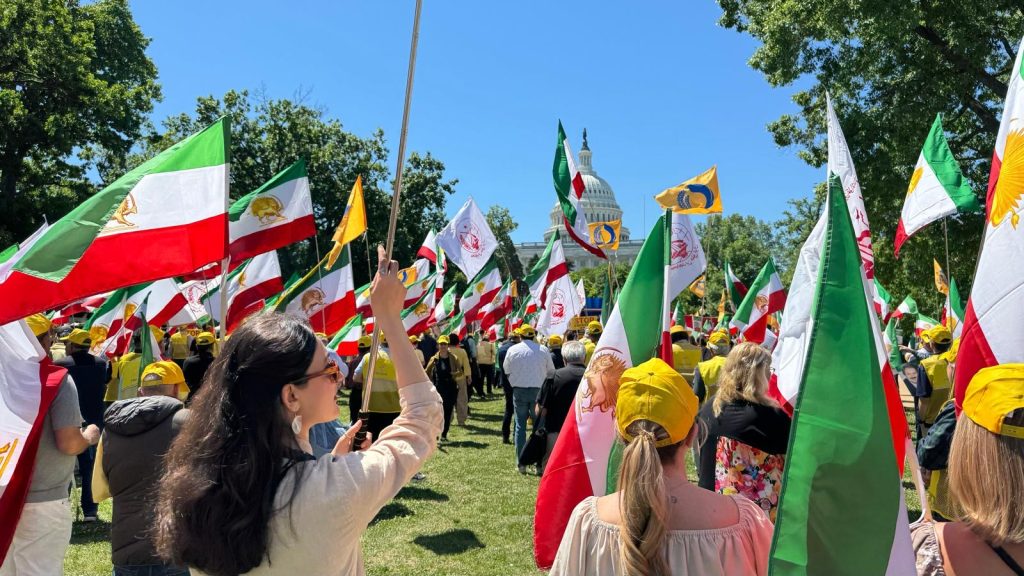
U.S., others should support post-regime forces
By Carla Sands – The Washington Times, Thursday, May 21, 2026
In the aftermath of the military conflict between Iran and the United States, the Iranian nation itself stands at a historic crossroads.
The death of Supreme Leader Ali Khamenei and the cumulative impact of 40 days of war have left the religious dictatorship in a more fragile position than at any other point in its history.
Yet the regime’s vulnerability did not begin with recent events. For years, it has been eroded by deepening international isolation, economic collapse, and recurring nationwide uprisings supported by an increasingly organized opposition movement.
For 47 years, Western powers have vacillated between appeasement and confrontation in their approach to Iran. The former has consistently emboldened Tehran’s aggression, while the latter has demonstrated its clear limitations.
When the shah’s dictatorship was overthrown in 1979, the world saw the Iranian people’s capacity to bring about change. However, that opportunity was quickly hijacked by an Islamist faction led by Ayatollah Ruhollah Khomeini.
Owing to its medieval outlook, incompetence and ruthlessness, that regime never achieved legitimacy in the eyes of the Iranian people. From the outset, activists and dissidents resisted the new regime.
No organization played a more sustained role in that resistance than the People’s Mojahedin Organization of Iran (MEK). After contributing to the shah’s downfall, the MEK refused to endorse the constitution that institutionalized clerical rule. As a result, it became the regime’s primary target.
MEK members accounted for the vast majority of the estimated 30,000 political prisoners executed during the 1988 massacre. Despite this attempt at eradication, the organization endured and continued to grow. Even today, its members remain among the principal targets of the regime’s renewed wave of executions.
In recent weeks, among the 25 dissidents put to death, eight of them were MEK members. This surge underscores the regime’s growing reliance on repression in the face of mounting internal pressure. In protest to the wave of executions, 100,000 people will take part in a rally on June 20 in Paris, calling for a halt to executions and in support of a democratic republic.
Politically, the National Council of Resistance of Iran has gained increasing prominence. Its president-elect, Maryam Rajavi, articulates a clear vision for Iran’s future through a Ten-Point Plan that calls for a democratic, secular, non-nuclear republic. The coalition’s credibility was significantly enhanced in 2002 when it exposed key elements of Iran’s clandestine nuclear weapons program.
Carla Sands is a former U.S. ambassador to Denmark (2017-2021) and a former member of President Trump’s Economic Advisory Council.