The emblem predates the Pahlavi dynasty by centuries; attempts to monopolize it distort Iranian history and mislead Western audiences
WASHINGTON, Oct. 7, 2026 — Iran’s green, white, and red flag bearing the Lion and Sun is sometimes identified, inaccurately, in Western political and media circles with the deposed Pahlavi monarchy.
The Lion and Sun emblem belongs to a much longer Iranian national tradition. Encyclopedia Iranica traces the emblem’s recognition as a symbol of Persia to the Safavid era, centuries before foreign powers installed the Pahlavi dynasty in 1925. By the Qajar period (1789 to 1925), it had become an official national emblem and appeared on Iran’s flags, coins, medals, and state insignia.
The green-white-red tricolor likewise predates the Pahlavi’s. The Lion and Sun tricolor flag was designated as Iran’s national flag during the Constitutional Revolution of 1906–1911 and was formally defined under the constitutional order created in that period. The Pahlavi monarchy simply inherited that flag and subsequently tried to modify elements of its design; it did not create either the Lion and Sun emblem or the tricolor associated with it.
When a National Symbol Becomes Political Branding
That history matters today because persistent efforts to associate the Lion and Sun exclusively with the Pahlavi monarchy can change how the symbol is understood outside Iran.
For those unfamiliar with Iran’s political history, seeing the flag at a rally or demonstration may now lead to an assumption that participants favor restoring the monarchy. Yet Iranians who explicitly reject both the ruling clerical regime and a return to monarchical rule carry the tricolor flag, which includes the Lion and Sun symbol in the middle.
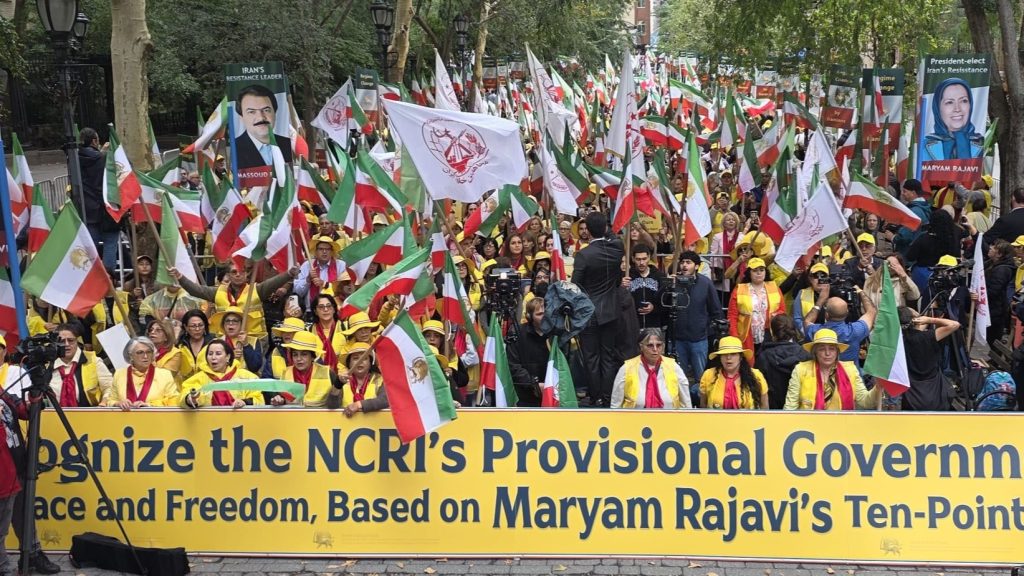
Recent demonstrations by supporters of the National Council of Resistance of Iran (NCRI) and its U.S. Representative Office (NCRI-US) illustrate this clearly. At rallies in Washington and New York, thousands of NCRI supporters have carried Lion and Sun flags while simultaneously calling for a democratic republic, supporting the Ten-Point Plan of Maryam Rajavi, the NCRI’s President-elect for the transitional period, and chanting slogans rejecting both the Shah’s and the ruling clerical regime.
The NCRI and the Lion and Sun
The NCRI formally adopted the Lion and Sun as its official emblem on August 29, 1993. Its resolution placed the emblem on Iran’s green-white-red tricolor and explicitly situated both within Iran’s national and constitutional heritage.
The NCRI resolution describes the tricolor as a legacy of Iran’s Constitutional Revolution and the Lion and Sun as an Iranian historical symbol. It declared that the flag used at NCRI ceremonies would bear the Lion and Sun emblem. The NCRI’s political program clearly rejects the monarchy and theocracy. It calls for a republic based on popular sovereignty and free elections.
Mrs. Rajavi has framed that principle in explicitly national rather than dynastic terms. Speaking about cooperation among democratic forces, she said they should “come together in a national solidarity front in the name of Iran, under the flag of Iran.”
That distinction is central to understanding the symbol.
A Flag Does Not Determine a Political Program
Political affiliation should be determined by what a movement advocates: its program, leadership, slogans, proposed form of government, and stated principles—not by assigning proprietary political ownership to a centuries-old national emblem.
The Lion and Sun survived successive Iranian dynasties as it is part of Iran’s heritage. It belongs to Iran—not to a dynasty or a political faction.
About the Iranian Resistance
The National Council of Resistance of Iran (NCRI) is a coalition advocating a democratic, secular republic in Iran. Maryam Rajavi, the NCRI’s President-elect for the transitional period, has outlined a Ten-Point Plan for a future democratic Iran. The People’s Mojahedin Organization of Iran (PMOI), also known as the Mujahedin-e Khalq (MEK), is the NCRI’s principal organized movement.