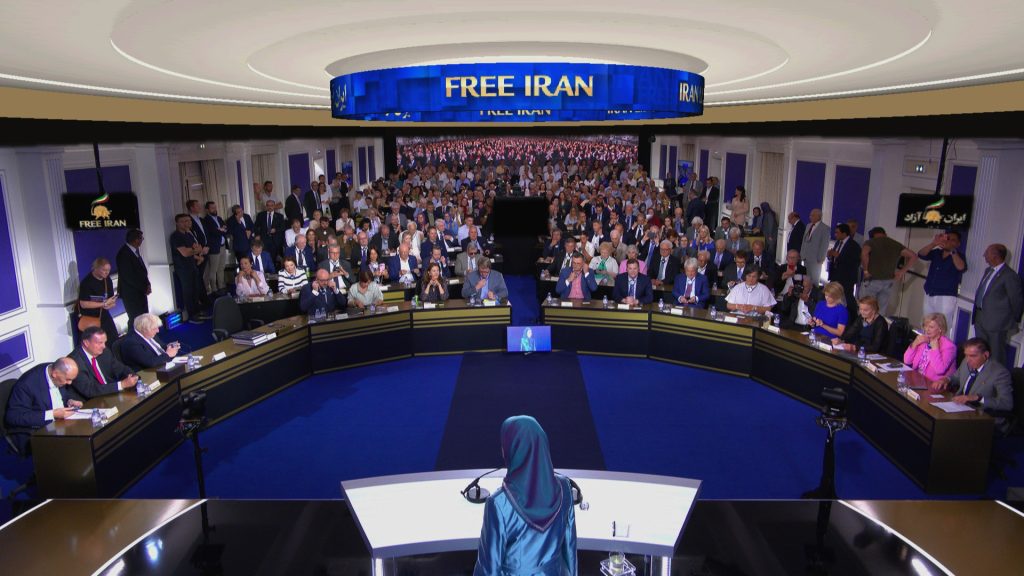
During the Free Iran World Summit – June 20–21, 2026, held in Paris, Mrs. Maryam Rajavi, President‑elect of the National Council of Resistance of Iran (NCRI), delivered two major speeches outlining the path toward a democratic, secular, non‑nuclear republic in Iran.
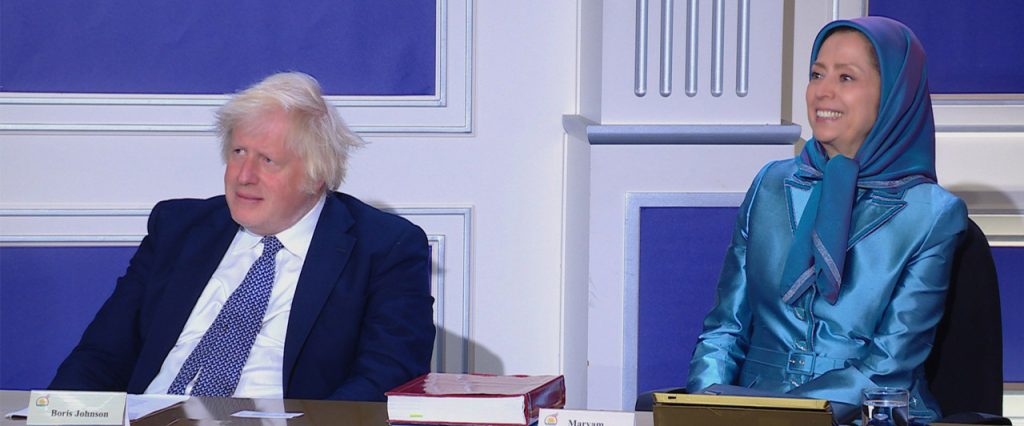
The gathering brought together thousands of Iranians and a remarkable array of international dignitaries, including former UK Prime Minister Boris Johnson, former Belgian Prime Minister Charles Michel, former Canadian Foreign Minister John Baird, former Foreign Minister of Ukraine Dmytro Kuleba, former U.S. Senator Joseph Lieberman, former U.S. Vice‑Chief of Staff of the Army General Jack Keane, former U.S. National Security Advisor General James Jones, former U.S. Assistant Secretary of State Robert Joseph, former French Foreign Minister Bernard Kouchner, former Italian Foreign Minister Giulio Terzi, and many other political, military, and human‑rights leaders from Europe, North America, and around the world.
These leaders emphasized a unified message: reject appeasement, support the Iranian people’s uprising, and recognize the NCRI as the democratic alternative to the ruling theocracy.
Mrs. Maryam Rajavi, President‑elect of the National Council of Resistance of Iran (NCRI), served as a keynote speaker on both days of the Free Iran World Summit, June 20–21, 2026. She delivered two major addresses outlining the path toward a democratic republic in Iran, the role of the organized Resistance, and the urgent need to end appeasement toward the ruling theocracy. Her speeches from Day 1 and Day 2 are presented below in full.
Global Leaders Back the Iranian People at Free Iran 2026
At the Free Iran World Summit in Paris, prominent international leaders—including former UK Prime Minister Boris Johnson, former Belgian Prime Minister Charles Michel, former Canadian Foreign Minister John Baird, former Ukrainian Foreign Minister Dmytro Kuleba, and senior U.S. and European military and political officials—called for an end to appeasement and affirmed support for the Iranian people’s struggle for a democratic, secular republic.
DAY 1 — “A Democratic Republic Is the Only Path to Peace and Freedom in Iran”
On the 45th Anniversary of the June 20, 1981 Uprising
My fellow compatriots,
We honor the 45th anniversary of the nationwide Resistance—the day of Iran’s martyrs and political prisoners, and the anniversary of the founding of the National Liberation Army of Iran.
Forty-five years of uninterrupted resistance by an entire people against the monster of religious tyranny constitute our greatest asset in the struggle for freedom. This movement, founded by Massoud Rajavi, is destined to turn the darkest pages in Iran’s contemporary history.
He said:
“Khamenei is dead, and the people will rise to life. The Iranian nation, together with its courageous sons and daughters, stands poised for the decisive battle through uprising and overthrow—the battle of all battles to end a century of dictatorship and herald the blessed birth of freedom and a democratic republic.”
Our Slogan Is Peace and Freedom
Khamenei’s son, who for more than a quarter of a century was his father’s accomplice in massacres and repression, has now inherited the crumbling edifice of Velayat-e Faqih. Yet his is a transient rule, with the inevitability of its overthrow written across its forehead. This is the regime’s final stop.
To the remnants of this regime, we say: whichever path you choose, uprising and overthrow await you.
Against the rebellious youth and the rebellious cities of Iran, your missile cities are powerless.
Against an organized uprising, your staged street spectacles are of no avail, and the daily execution of political prisoners will not save your regime.
Fellow compatriots,
Today, let me first reaffirm once again that the Iranian Resistance—which for nearly five decades has stood for freedom and peace, and which for the past thirty-five years, through 133 major revelations, especially the exposure of the secret nuclear facilities at Natanz and Arak in August 2002, has been the foremost obstacle to this regime’s acquisition of the atomic bomb—welcomes any understanding that brings an end to the war and to the suffering of the Iranian people.
In Iran, no one except the remnants of the mullahs and the Shah has ever desired war.
The pursuit of nuclear weapons, warmongering, and interference in the affairs of neighboring countries are integral to this religious dictatorship’s strategy for survival, and it will not abandon them willingly. War has been this regime’s shield against popular uprisings, while peace and a ceasefire are, as Khomeini himself admitted, “like poison.”
The overthrow of this regime is the responsibility of the Iranian people and their organized Resistance—true to the enduring principle that no one else can do for us what we must do ourselves.
The fact that, in less than twenty-four hours after signing the Memorandum of Understanding, Khamenei’s son expressed opposition to it and declared that he was “opposed to it in principle” exposes a deadly schism at the helm of the regime, showing just how unstable and precarious it is.
There Is Only One Way to Save the Iranian People
To the ruling mullahs I say: lay down your shields of war, executions, and massacres against the uprisings. Then you will witness what the eruption of decades of suppressed anger will do to your decaying regime.
The decisive battle is between the people of Iran and this dying regime—a regime that is trapped in a dead end no matter which way it turns.
It is a regime that has condemned tens of millions of Iranians to hunger. Many survive on nothing more than dry bread, with scarcely enough to sustain life.
There is only one way—one way alone—to save the people of Iran: the overthrow of this vile regime through a democratic revolution.
Ultimately, this fate is inevitable for the regime.
The regime’s desperate efforts to prevent the grand Free Iran Rally reflect the mullahs’ fear of this destiny.
The Paris Administrative Court cited intelligence reports and declared that the June 20 rally “is exposed to the risk of a major attack by the Iranian regime or Iranian monarchists,” and that SAVAK had threatened to bomb the demonstration and that its supporters had been called upon to block the march.
Remnants of the Shah’s regime are accomplices and instruments of the religious dictatorship in the face of the Iranian people and Resistance.
They tremble and shake at any hint of the PMOI/MEK and the National Council of Resistance of Iran because this movement is their highest red line and most serious existential threat.
Since the outset, and very explicitly, Khomeini declared on June 25, 1980, that he feared not the United States, nor the Soviet Union, nor others, but the Mojahedin who were in Tehran. He correctly saw the antithesis of his hypocritical Islam in the PMOI, and for this reason the slogan “Death to the hypocrites” became the principal motto of his regime. Ultimately, he issued the edict for the massacre of all PMOI members who stood their ground.
Over the past four decades, neither negotiations nor war have provided an answer to the threat posed by religious fascism.
We warned that religious fascism and fundamentalism in the name of Islam constituted the greatest threat facing the world today. But no one listened.
Today, we repeat: a peaceful, non-nuclear Iran is possible only through the overthrow of this regime by the Iranian people and their organized Resistance.
The sovereignty of the people, the preservation of Iran’s territorial integrity, and peaceful coexistence with neighboring countries and with the entire region—yes, all of these depend upon the establishment of a democratic republic.
The Real Force for Change
The path to Iran’s freedom is not a foreign war. Nor is it waiting for the regime to collapse of its own accord.
The path to Iran’s freedom is not the fabrication of artificial, fake alternatives.
The real force for change is on the ground. It rises from a people who aspire to a free and just society—from those devoted and enlightened young men and women who say “No” to both the Shah and the mullahs, together with an organized Resistance that has accumulated sixty-one years of experience in the struggle against two dictatorships.
Five days before the outbreak of the recent war, at dawn on February 23, 250 PMOI freedom fighters struck Khamenei’s headquarters in the heart of Tehran.
A few weeks earlier, during the January uprising, the Resistance Units carried out 630 operations against the regime’s centers and forces of repression.
You all remember that in 2003, at Ashraf in Iraq, approximately 20,000 light and heavy weapons, together with 20,000 tons of ammunition, were taken from the PMOI/MEK. Those weapons had been captured from Khomeini’s regime in one hundred operations conducted by the National Liberation Army of Iran, or had been purchased with the PMOI’s own resources.
In an official statement issued on May 17, 2003, CENTCOM announced that it had collected 2,139 tanks, armored personnel carriers, artillery pieces, and anti-aircraft weapons from the PMOI/MEK.
One must ask: for what purpose, and to whose benefit, were the weapons of the PMOI and the National Liberation Army taken from them?
Had the National Liberation Army of Iran retained its weapons and ammunition along Iran’s borders, there is no doubt that the fate of the Iranian people’s uprisings in 2017, 2019, 2022, and 2025 would have been fundamentally different.
For, as Massoud Rajavi said: “The Army of Freedom is the only path to freedom.”
Iran’s Future Lies in a Democratic Republic
My fellow compatriots,
During the January uprising, the rebellious youth in the streets embraced the path of the Army of Freedom.
Standing proudly before the regime’s kangaroo courts, they openly declared that they had risen to overthrow the regime.
Yet those who commanded a multi-billion-dollar machinery of fabrication and lies sought to hijack the uprising and portray it as an attempt to restore the monarchical dictatorship.
In practice, this served Khamenei’s interests entirely. It functioned as an instrument for suppressing the uprising.
Across the streets of Europe, they staged parades bearing the emblems of SAVAK, the Shah’s notorious secret police, and the insignia of the Imperial Guard.
They speak openly of imposing martial law.
Our Kurdish compatriots are bombarded by the Revolutionary Guard Corps, while the remnants of the Shah accuse them of separatism.
We say instead that autonomy is the undeniable right of those nationalities that have long endured double oppression.
Yes, Iran’s future—and peace and freedom in Iran—lie in the establishment of a democratic republic.
It is precisely for this purpose that the National Council of Resistance of Iran has announced the formation of a Provisional Government to transfer sovereignty to the people through free elections for a Constituent Assembly and a National Legislative Assembly within six months.
My Commitment
If you ask what guarantee there is that such a republic will remain faithful to these lofty ideals, seek the answer in the generations who, throughout a sixty-one-year struggle against both the Shah and the Sheikh, have entered the battlefield inspired by the ideals of freedom.
Time and again, steadfast PMOI prisoners wrote to me from their prison cells: “We shall stand firm until the very end.”
Now, in answer to these steadfast martyrs, to the martyrs of the 1988 massacre, to every steadfast political prisoner, to the generation that has entered this struggle prepared to sacrifice everything to defeat this regime, and above all before the people of Iran, let me declare:
Every drop of blood they spilled from your bodies throughout these forty-eight dark years;
Every lash that fell upon your backs;
Every minute of your lives spent captive in dungeons and torture chambers;
And everything in your lives that was destroyed by poverty, the pandemic, and the regime’s warmongering—
All of it only deepens my responsibility and that of the entire Resistance movement.
My commitment is an unbreakable covenant to secure freedom for all the people of Iran—regardless of their ethnicity, political conviction, beliefs, religion, or creed.
My commitment is to defend Iran’s freedom, honor, and independence against every form of dictatorship and every form of subjugation, however arduous and winding the road may be, through its seven trials of hardship and suffering.
But what of that?
We remain steadfast in this covenant.
This is my pledge, and it is our pledge.
Our covenant with the martyrs who fell for freedom.
Our covenant with the people of Iran.
Our covenant with Massoud Rajavi—
Until our last breath,
Until our last drop of blood.
DAY 2 — “Change in Iran Can Be Realized Only by a Fighting Force on the Ground”
On the forty-fifth anniversary of the nationwide Resistance of the Iranian people against religious fascism, I pay tribute to the pioneers of that great uprising on June 20, 1981, and to all the heroes and martyrs of the continuous, arduous, and blood-soaked struggle of these long years. To them, I say: salute, salute, salute!
This Resistance began with the uprising of half a million people in Tehran on June 20, 1981—the most significant political turning point after Khomeini seized power.
The choice before us was stark: existence or extinction, freedom or dictatorship, resistance or surrender.
We chose resistance.
Massoud Rajavi’s message was simple and enduring: “I resist for freedom; therefore, I am.”
This is a Resistance that carries the most legitimate, the deepest, and the most hard-earned aspirations of the Iranian people over the past 120 years. It will continue its march until the democratic revolution of the Iranian people triumphs.
This year also marks the 120th anniversary of Iran’s Constitutional Revolution against absolute monarchy and tyrannical kings.
No to War, No to Appeasement
Honorable friends,
I salute the tens of thousands of Iranians who reached Vauban Square and its vicinity in Paris yesterday to rally but faced an unjustified ban on their demonstration. I particularly salute the younger generation whose voice was heard worldwide. The remnants of the clerical regime sought to silence their voice through behind-the-scenes dealings, but their roar, which is the most legitimate voice of the people of Iran, could be heard in the heart of Paris louder than ever.
Fortunately, the people of France and their honorable representatives loudly declared that, in contrast to the policy of appeasement of the regime, they stand with the Iranian Resistance, the National Council of Resistance, and the Resistance Units.
Furthermore, Ms. Christine Arrighi, a member of the French National Assembly, said here yesterday, “I am in pain for my France.” With this statement, she was referring to the ban on freedom of expression and assembly in Paris.
She added:
“Our point is: no to war, no to appeasement, and no to endless negotiations up until today. Instead, yes to uprising, yes to the freedom of the Iranian people through supporting their independent resistance to overthrow this ruthless regime.”
I also want to refer to the remarks made yesterday by distinguished dignitaries here, which served as a powerful act of support for this alternative and for the Iranian people’s movement to bring down the clerical dictatorship.
The remarks of Mr. Charles Michel, the former President of the European Council, could be summarized in one phrase. He said appeasement does not work—not under Nazism and not in Iran.
He said:
“Resistance Units, courageously, risking their lives, carry this hope and commitment for freedom, for a democratic Iran.
Ladies and gentlemen, the Iranian people have the right to choose. That is the fundamental question.”
What Is the Solution to the Crisis?
Honorable guests,
Today, at one of the most critical junctures in Iran’s history, the decisive question is: What is the solution to the crisis? How can—and how must—this regime be brought down?
For years, when the Iranian Resistance warned that a viper does not give birth to a dove—when we said that no one should look for moderation, reform, or a change of behavior inside the dark tunnel of Velayat-e Faqih, or religious fascism, and that appeasement was a dangerous illusion—many governments refused to accept it.
Today, however, the bitter and bloody lessons of experience have made many realities unmistakably clear.
Among them is the fact that theories of the regime’s spontaneous collapse, its overthrow through foreign military intervention, or the artificial manufacture of an alternative centered on the remnants of the Shah’s dictatorship—whether promoted through virtual campaigns or robotic networks—serve only the interests of the ruling clerics.
In contrast, one truth has emerged with unmistakable clarity: the only solution to Iran’s present crisis is regime change. And that change can only be achieved through the uprising of the Iranian people and their organized Resistance.
The Force for Change
The central issue is this: change in Iran requires a force capable of bringing about that change.
It requires a force that can fight under the harshest repression; a force that can stand shoulder to shoulder with the people’s uprising and remove the Revolutionary Guards from the path of the Iranian people.
Look at this book. It contains the names—and some of the photographs—of 20,000 men and women of the PMOI/MEK who gave their lives for freedom. They represent just 20,000 of the Resistance’s 100,000 martyrs.
The second book contains the names and photographs of more than 5,000 PMOI/MEK members who were hanged during the 1988 massacre, in which 30,000 political prisoners were executed.
Yet the story is not over. It continues to this day.
We keep rowing the boat of Resistance through a sea of suffering and blood, pressing forward despite every obstacle. As Massoud Rajavi says:
“We are stronger than deaths, executions, and massacres. Whenever we are reaped, we rejuvenate with more sprouts. We rise up, we revolt, and we continue to uproot the foundations and structure of the enemy, the very principle of Velayat-e Faqih (or absolute rule of the supreme leader).”
And, of course, the demonization campaigns against the Resistance continue.
In June 2003, at this very time of year, twelve governments were mobilized against us. Terrorist designations were imposed, and a 100,000-page judicial case was fabricated against the Resistance. It took fifteen years in the courts for every single allegation to be proven false.
In the end, we emerged from every one of those battles with our honor intact. But the regime paid no price. Instead, those policies prolonged the life of the ruling clerics by at least two decades.
Actions by figures such as Chalabi paved the way for the disarmament of the Mojahedin (PMOI/MEK) in Iraq and the seizure of its fourteen bases along Iran’s border. Yet we did not yield.
Instead, the Resistance Units ignited the engines of resistance across Iran.
They are made up of courageous and committed young men and women who dedicate everything they have to the freedom of their people and their homeland.
They constitute the most important organized force within the uprisings.
The Answer to Iran’s Equation
Now look at the generation that has joined the ranks of the Resistance Units.
Look at the young rebels who stand tall before the regime’s sham courts and proudly declare that they have risen to overthrow the dictatorship.
Look at Vahid Bani-Amerian and his heroic unit, who inspired Iranian society from behind prison walls and earned the admiration of the world.
They were executed in April of this year.
All they had to do to save their lives was utter a single word against the PMOI. Instead, they told their executioners:
“We do not bargain with you over our ideals, our beliefs, or our lives.”
This is why I say that, with such an organized Resistance on the ground, and with an alternative that has been tested for forty-five years through the fiercest domestic, regional, and international trials, the equation of Iran has found its answer.
And this comes at a time when the ruling theocracy is weaker and more desperate than ever before.
Now, Khamenei, who had consolidated thirty-seven years of unchallenged rule, is gone. His son has proved incapable of filling the vacuum. Even nearly half the members of the Assembly of Experts—an institution shaped by his own father—refused to support him.
Politically, the regime has reached a dead end. It sees peace as the hangman’s noose, yet it can find no salvation in the fires of war.
You saw that he dismissed the recent Memorandum of Understanding in just a few hours, saying that he had “a different opinion in principle.”
The regime’s new supreme leader said he had allowed the signing of the MOU only because (Masoud) Pezeshkian and members of the Supreme National Security Council accepted its responsibility and made a commitment to “protect the rights of the people of Iran and the Resistance Front.”
What he meant by “the rights of the people of Iran” are actually the red lines of religious fascism. Similarly, by “Resistance Front,” he means persisting in the policy of exporting war to the region—policies and red lines that are absolutely essential to the regime’s survival.
At the same time, every economic, social, and political factor that gave rise to the January 2026 uprising has intensified. The explosive potential of Iranian society has grown even greater.
For all these reasons, this Resistance and this democratic alternative deserve international recognition and support.
A Movement That Has Inscribed the Regime’s Downfall on Its Forehead
Just imagine what would have happened had this Resistance not exposed the regime’s clandestine nuclear program.
I am referring to the disclosures that began in 1991, and especially the revelation of the Arak and Natanz nuclear facilities in 2002.
Over the years, through 133 separate disclosures concerning the regime’s nuclear and missile programs, the Iranian Resistance became the single most important force preventing the ruling clerics from acquiring the atomic bomb.
Even today, the regime itself acknowledges that the source of its greatest troubles has been the PMOI—from the very first days after the 1979 revolution, and especially since the turning point of June 20, 1981.
After all, among nearly two billion Muslims, while Khomeini claimed religious leadership over the Islamic world, the PMOI stood for a tolerant and democratic interpretation of Islam—one that upholds the equality of women and men.
Our understanding of Islam has never been defined by divisions between veiled and unveiled women, Muslims and Jews or Christians, Shiites and Sunnis, or Persians and Kurds or Baluchis.
But the greatest achievement of this forty-five-year Resistance is something even more enduring.
It is the creation of a living, dynamic movement that has made the struggle against religious tyranny the defining spirit of successive generations.
Yes, this is the movement that has inscribed the certainty of the regime’s downfall upon its very forehead.
The Provisional Government: A Symbol of the Resistance
The Provisional Government announced by the National Council of Resistance of Iran is the embodiment of this Resistance and of this solution.
It is the path toward a democratic republic that rejects both the dictatorship of the Shah and the tyranny of the Sheikh.
Its principal mission is to transfer power to the people of Iran. Within no more than six months, it must organize free and fair elections for a Constituent Assembly.
Once that Assembly is elected, sovereignty will be transferred to the representatives of the people. The Constituent Assembly will then be entrusted with drafting and adopting the constitution of the new republic.
I have said before that we are not seeking to seize power.
We are prepared to transfer power from the tyrannies of the Shah and the Sheikh to their rightful owners—the people of Iran.
After sixty-one years of struggle, this is the noblest summit and the highest aspiration before us.
We do not seek power for ourselves.
We seek to transfer sovereignty to the people of Iran.
This is my pledge—to all the martyrs, to every member of the Resistance and every fighter for freedom, to Massoud, and to the people of Iran.
The day I laid my head at the feet of Freedom,
I renounced my very life for Freedom’s sake.
That I might one day grasp the hem of her garment,
I run headlong in pursuit of Freedom.
The Remnants of the Shah’s Dictatorship: An Obstacle to Democratic Change
In the course of this determined and sacrifice-filled struggle to overthrow the regime and transfer power to the people, the remnants of the Shah’s dictatorship have acted as an obstructive and destructive force.
One newspaper affiliated with the ruling clerics wrote quite openly that the activities of the monarchists are an “opportunity” and a “blessing” for the Islamic Republic.
It explained why: because they sow division within the opposition and present the international community with a false alternative.
The paper stated: “By creating divisions among the opposition, they have rendered a service to the Islamic Republic that no other group has been capable of providing.”
It went on to conclude that this current “can help ensure the survival of the Islamic Republic. This is the service the royal family renders to the people of Iran.”
Now, the supporters of SAVAK claim they achieved their goal with the banning of the Iranian Resistance’s rally in Paris. Indeed, this is the shared goal of SAVAK, the regime’s foreign minister, and the Revolutionary Guard Corps (IRGC).
The people of Iran, however, have risen to reject all forms of dictatorship, and they will leave no room for the Shah and the Sheikh.
The Shah’s heir himself has made no secret of his intentions. He openly declares that change in Iran should be achieved with the assistance of the Revolutionary Guards and the regime’s security and intelligence apparatus—forces that, in his view, should continue to play a decisive role in the future.
He presents media-driven campaigns and virtual engineering as evidence of popular support. He has even described the Shah’s torture and execution of PMOI members and other freedom fighters as, in his own words, a source of “pride.”
But the reality is this:
In the arena of genuine struggle and repeated popular uprisings, there is no longer any place for power to pass back and forth between the Shah and the mullahs.
The Watchwords of the Resistance and the Provisional Government: Peace and Freedom
Allow me to conclude by summarizing the central points of my remarks.
First: From the standpoint of the Iranian people, neither the so-called election by the Assembly of Experts nor the installation of Khamenei’s son carries the slightest legitimacy or credibility. He is a partner in the crimes committed over the past three decades.
Second: History will not turn back. Iran will not return to the rule of the remnants of the Shah’s dictatorship. As the Iranian people say, that is like pounding water in a mortar—a completely futile exercise.
Third: The National Council of Resistance of Iran and the Provisional Government are fighting to transfer sovereignty to the people of Iran and to establish a democratic republic.
The watchwords of the Resistance and the Provisional Government are: Peace and Freedom.
The Iranian Resistance welcomes every genuine agreement that brings an end to war and relieves the suffering of the Iranian people.
The pursuit of nuclear weapons, the export of war, and interference throughout the region are integral to the religious dictatorship’s strategy for survival, and it will not abandon them willingly.
I have said this many times, and I repeat it today:
The overthrow of the ruling religious dictatorship, and the achievement of freedom and a democratic republic, are the responsibility of ourselves, our people, and the National Liberation Army of Iran.
Peace and freedom will prevail in Iran.